La Liga history and records — key marks compared with the Tanzania Premier League
La Liga history and records and what East African fans should know
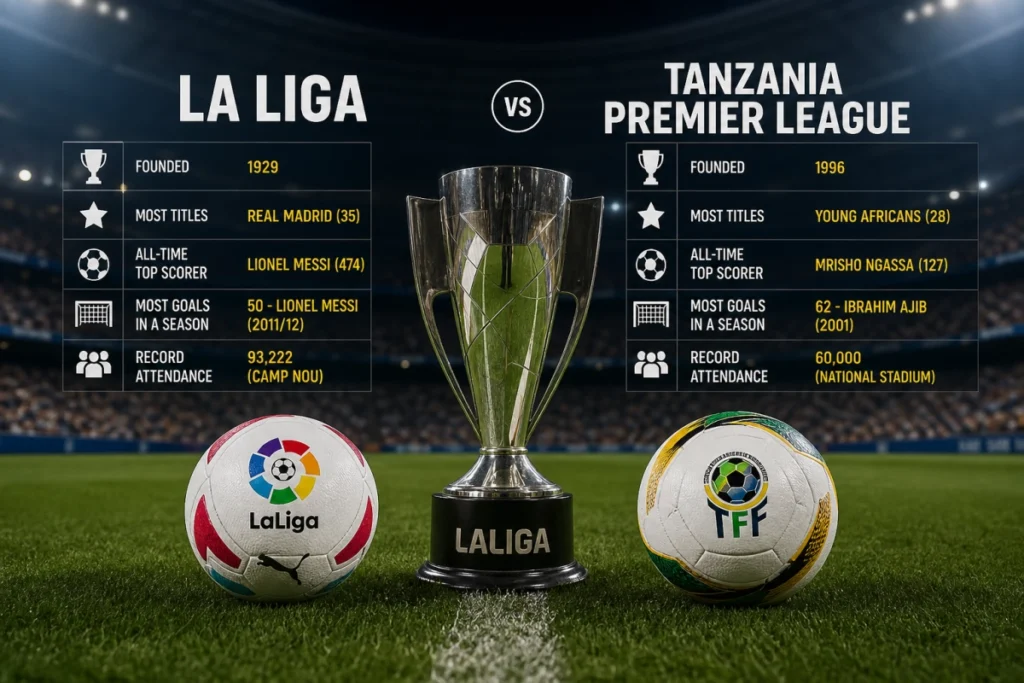
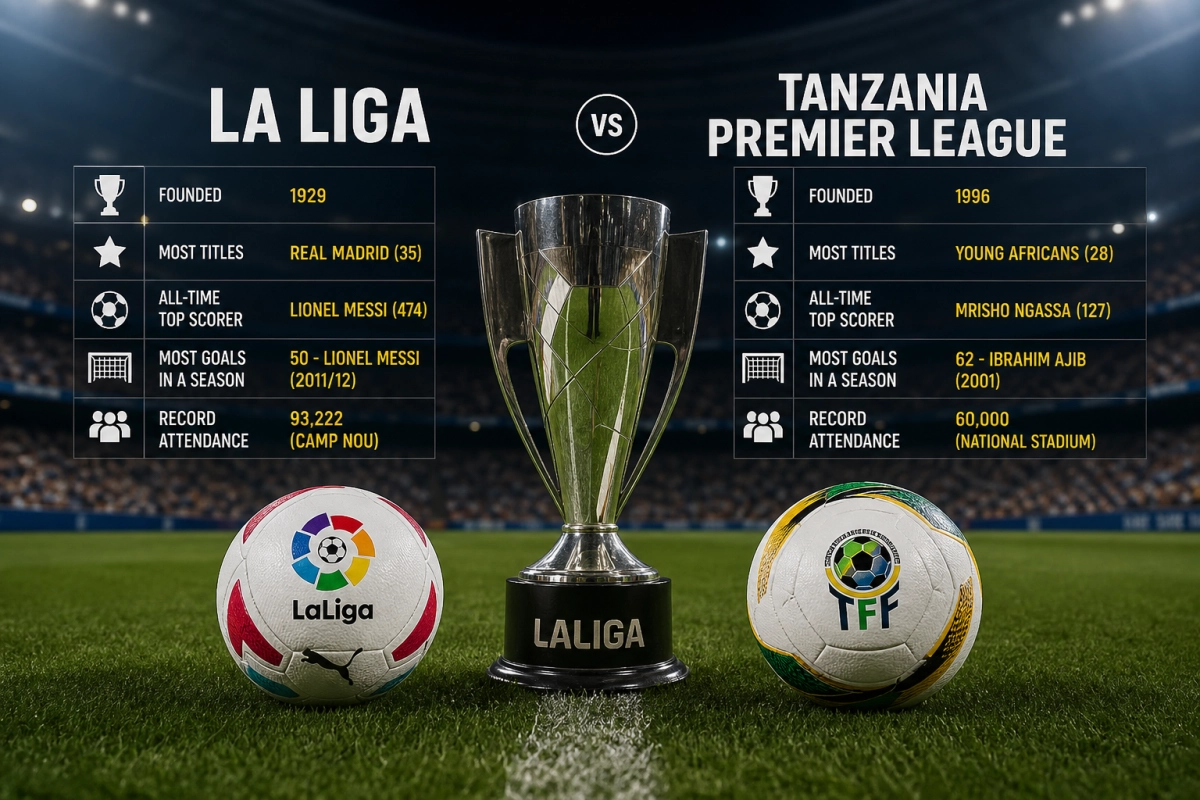
This piece on La Liga history and records shows the competition’s landmark numbers — top goal scorers, highest single‑season totals and most appearances — and compares them to equivalent figures in the Tanzania Premier League (TPL). Readers will get clear data, short player and club profiles, and practical context explaining why the gaps exist (season length, professional resources, playing styles and transfer markets).
Top La Liga goalscorer vs typical Tanzania Premier League finishing totals
Confirmed La Liga facts:
- Lionel Messi is the all‑time La Liga top scorer with 474 goals (for Barcelona, 2004–2021).
- Messi also holds the La Liga single‑season scoring record with 50 goals in 2011–12 (38‑match season).
These records reflect a 38‑match calendar and decades of global talent concentrated in Spain.
How that compares with the Tanzania Premier League (approximate ranges)
The TPL operates on a different scale. Typical top‑scorer totals are about 15–22 goals in a ~30‑match season; single‑league career totals for the best domestic players often remain under 200 because many move abroad or to regional clubs. Numerically, Messi’s single‑season mark is roughly 28–35 goals higher than a TPL top finish; his career total exceeds most domestic careers by a few hundred goals depending on player movement.
Notes: La Liga numbers above are confirmed historical records. TPL figures are typical ranges rather than definitive records — seasonal and career stats in Tanzania vary with transfers and club careers.
Why the scoring gap exists: structural and historical reasons
Key factors explaining the difference between La Liga records and TPL figures:
- Season length and fixtures: 38 matches in La Liga versus ~30 in the TPL mean more scoring opportunities per campaign.
- Player concentration and finances: Spain attracts elite attackers and provides advanced support (training, analytics, nutrition).
- Career movement: East African talents often transfer abroad, fragmenting single‑league totals.
- Tactical and infrastructure differences: La Liga’s attack‑oriented systems and better pitches generate clearer chances; TPL matches can be more physical with variable surfaces.
Short profiles tied to these records
Lionel Messi (La Liga profile): Argentine forward whose longevity, consistent starting role and a Barcelona team built around him produced 474 La Liga goals and a 50‑goal season.
Simba SC (Tanzanian club context): One of Tanzania’s biggest clubs; top scorers there often lead domestic charts but face resource limits, continental travel and transfers that cap single‑league career totals.
Most La Liga appearances and how player longevity compares with the Tanzania Premier League
La Liga’s appearance benchmark is Andoni Zubizarreta — 622 La Liga outings across Athletic Bilbao, Barcelona and Valencia (1981–1998). That total reflects long seasons, consistent selection and top‑level medical support.
By contrast, many TPL stalwarts who remain domestic compile roughly 300–420 appearances over long careers. The typical numerical gap versus La Liga’s upper bound is therefore on the order of a couple of hundred matches, influenced by transfers abroad and shorter elite careers.
Why the gap exists:
- Denser seasons and continental fixtures: La Liga players accumulate more matches across domestic and European competitions.
- Medical and recovery infrastructure: Spanish clubs’ sports science extends elite careers; limited rehab resources shorten or interrupt careers in East Africa.
- Transfer patterns: Moves abroad reduce single‑league appearance totals for TPL standouts.
Profiles: Andoni Zubizarreta — a durable goalkeeper whose position and consistent selection produced a record few outfield players approach. In Tanzania, long‑serving names at clubs like Young Africans compile 300–400 domestic appearances but rarely reach La Liga extremes due to structural factors and outward moves.
Longest unbeaten runs and biggest wins — dominance, competitive balance and scoreline extremes
La Liga’s longest unbeaten streaks and biggest wins reflect eras of dominance by clubs like Barcelona and Real Madrid: modern unbeaten runs can exceed 30 matches, while historical blowouts are rarer in the professional era. The TPL sees extended domestic runs too, but they are typically shorter (around 12–25 matches) and heavier single‑match margins still occur when top clubs meet weaker sides.
Reasons for the contrasts:
- Squad depth and rotation: Spanish champions rotate across competitions to sustain form; TPL clubs often lack comparable depth.
- Professional standards and pitch quality: Better surfaces and tactical consistency in Spain reduce unpredictable upsets and support long runs.
- Financial parity: Gaps between top and bottom clubs create the conditions for heavy defeats in both leagues where inequality is pronounced.
Club snapshot: FC Barcelona — periods of prolonged domestic invincibility driven by world‑class squads. Simba SC and Young Africans — domestic giants capable of long unbeaten stretches in the TPL, though structural limits usually cap runs below La Liga’s longest.
Transfer‑market and managerial records — money, movement and leadership
La Liga transfer‑market benchmarks (selected, context)
- Neymar’s move from Barcelona to PSG (~€222m, 2017) remains a global transfer ceiling and the largest outgoing fee involving a Spanish club.
- João Félix to Atlético Madrid (reported ~€126m, 2019) and other €100m+ signings show how La Liga clubs invest in stars using vast broadcast and commercial income.
- These fees reflect global demand, commercial reach and broadcast revenue not available at similar scale in East Africa.
Tanzania Premier League and East African transfer norms (estimates and comparison)
- Top domestic TPL transfers commonly sit in the low‑to‑mid five‑figure USD range for intra‑league moves (≈$10k–$75k).
- Regional or international moves can fetch mid‑to‑high five figures or low six figures ($50k–$500k); occasional outliers near or above $1m occur when European interest or strong continental exposure exists.
- Comparing €100–€222m fees with typical East African peak fees shows a magnitude‑gap of hundreds to thousands (roughly 200×–4,000×), driven by revenue differences more than player potential alone.
Managerial records — longevity and context
- La Liga has examples of long tenures (historic long projects and modern multi‑season plans) supported by institutional stability and deep sporting departments.
- TPL and East African clubs commonly have shorter managerial tenures due to immediate performance pressure, contract insecurity and financial limits; some big clubs invest in longer projects and foreign technical staff, but this is not yet widespread.
- Managerial stability correlates with talent development, consistent strategy and better negotiation of outgoing transfers.
Short player and club profiles linked to these records
- Lionel Messi (La Liga): longevity, role continuity and a club built around him produced exceptional scoring and career records.
- Neymar / Barcelona (transfer context): the €222m sale illustrates how global market forces can reshape club finances.
- João Félix / Atlético Madrid: example of high‑cost investment in perceived future returns, funded by large revenues.
- Simba SC and Young Africans (TPL): dominant domestic clubs with strong support and continental ambitions, but constrained by smaller commercial and broadcast income compared with European sides.
Practical steps for East African clubs and supporters aiming to narrow specific gaps
- Prioritise youth development and retention: stronger academies produce more homegrown professionals and raise domestic standards.
- Negotiate smart deals and add sell‑on clauses: capture long‑term value when players move abroad.
- Professionalise sports science and medical care: better injury prevention and rehab lengthen careers and increase availability.
- Invest in coach education and technical staff: stable, data‑informed coaching improves tactics and scoring rates.
- Improve commercial and matchday revenue: sponsorship, broadcast packaging and fan engagement expand budgets for transfers and squad depth.
- Focus on pitch and infrastructure quality: better surfaces and training facilities raise technical standards and reduce result variability.
Looking ahead: why these records still matter for East African football
Records in La Liga are more than statistics — they are the by‑product of sustained institutional capacity: long seasons, deep finances, global markets and established coaching pathways. For East African leagues the numeric gaps highlight structural differences, but they also point to clear levers for change. Incremental investments in youth development, contract management, infrastructure and coach education will not suddenly create €100m transfers, yet they will raise domestic standards, increase export value for players, and give fans more competitive, skilled football to enjoy. The records therefore serve as benchmarks and inspiration: they show what is possible at the highest level and, more importantly, which practical steps clubs and stakeholders can start taking today to build their own distinctive records over the next decades.