La Liga History and Records: A Chronological Guide | Part 1
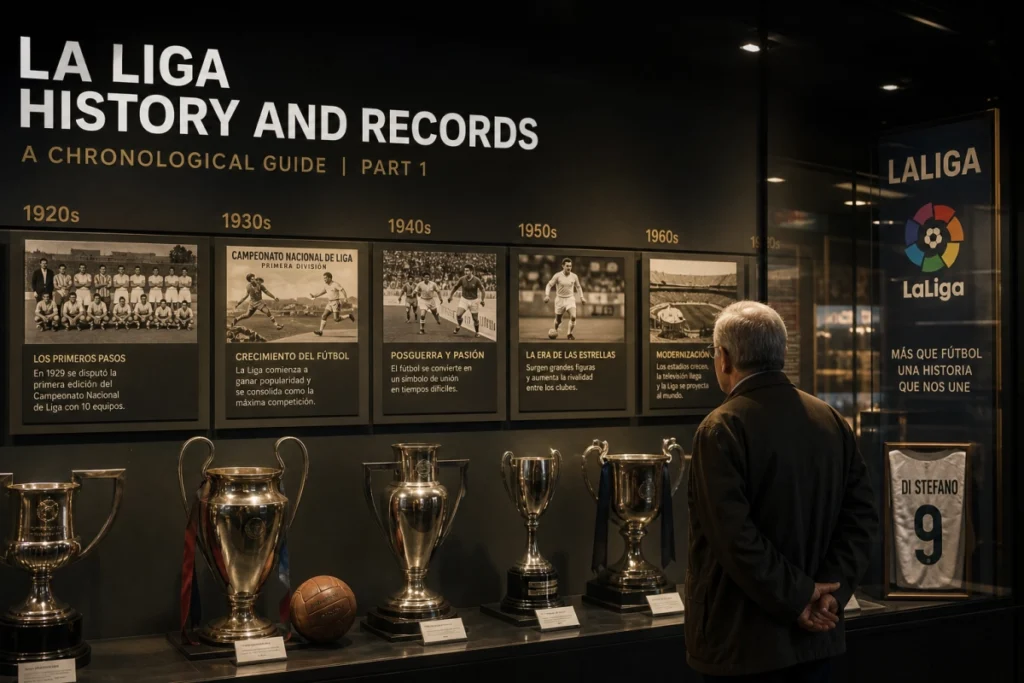
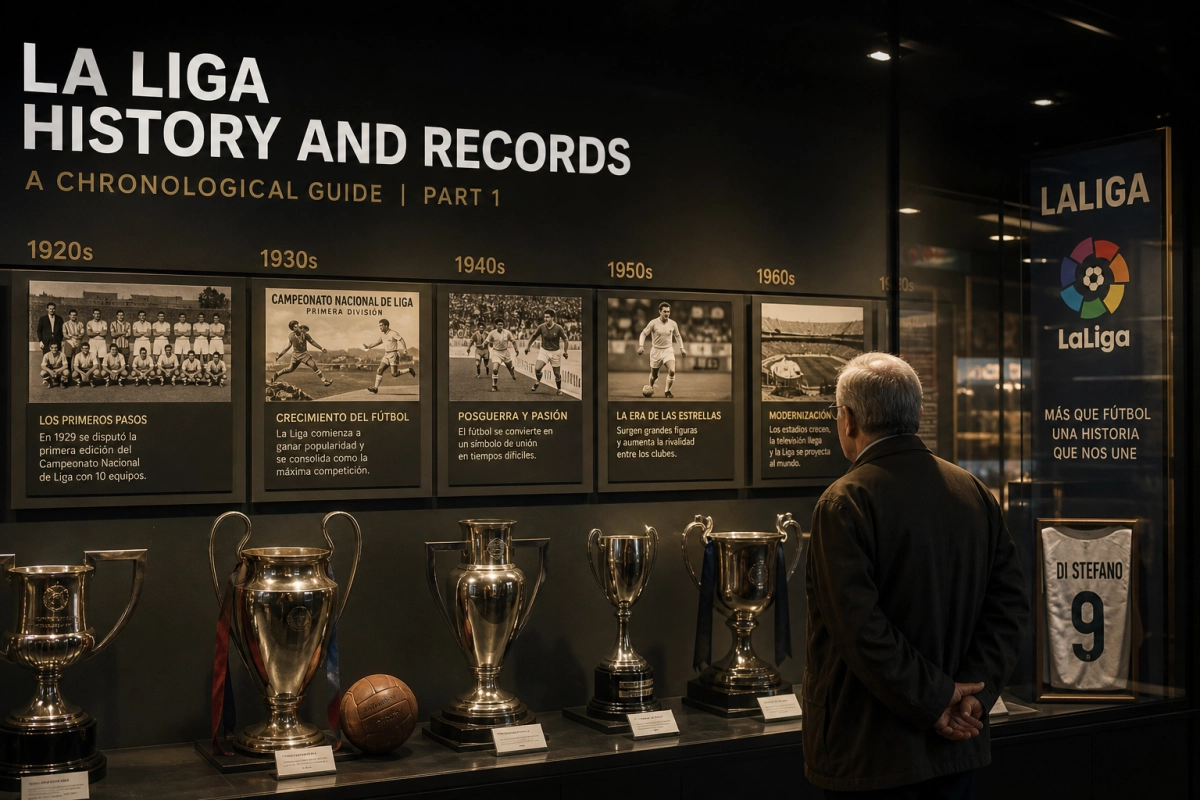
La Liga History and Records: A Chronological Guide
La Liga begins in 1929 and establishes its historic clubs
La Liga history and records begin in 1929, when Spain’s national league was created with 10 founding teams. Barcelona became the first champion after finishing the inaugural season at the top of the table. That opening campaign set the foundation for a competition that would later become one of the most followed leagues in world football, including among fans tracking international football scores in Tanzania and across East Africa.
The early years were competitive. Athletic Club, Barcelona and Real Madrid were among the leading clubs, while Spain’s Civil War interrupted league football between 1936 and 1939. When the competition resumed, Atlético Aviación—later known as Atlético de Madrid—won the first two post-war titles, in 1939–40 and 1940–41.
These early championships matter because they show that La Liga was not always dominated by only two teams. Several clubs helped shape its identity before Real Madrid and Barcelona became the competition’s most recognisable record holders.
From Zarra’s scoring era to Real Madrid’s first great dynasty
The 1940s and early 1950s produced one of La Liga’s first outstanding individual records. Athletic Club forward Telmo Zarra became the league’s leading historical scorer, finishing with 251 goals. His record stood for decades and reflected the importance of traditional centre-forwards, whose movement and finishing often decided close matches before modern tactical systems developed.
Barcelona enjoyed a powerful period in the early 1950s. The club won four league titles between 1947–48 and 1952–53, with players such as César Rodríguez contributing heavily in attack. However, the arrival of Alfredo Di Stéfano helped transform Real Madrid into the league’s first sustained superpower.
Real Madrid won five consecutive La Liga titles from 1960–61 through 1964–65. The achievement was significant not only because of the number of championships, but also because of the club’s consistency across an entire era. Real Madrid added a sixth straight title in 1965–66, giving the club one of the earliest major dynasties in Spanish football.
New scoring standards and increasingly close title races
As the league expanded and the points system changed, comparisons between different periods became more complex. Older seasons generally awarded two points for a win, while the modern system gives three. This means that raw points totals should be read alongside matches played, points available and the rules of the time.
Real Madrid continued to set important team benchmarks. In 1989–90, the club scored 107 league goals, a record that stood until the more attacking era of the early 2010s. That campaign demonstrated how a high-tempo attack could produce extraordinary numbers over a full season.
The 2013–14 title race later provided one of the closest finishes in modern La Liga history. Atlético Madrid, Barcelona and Real Madrid remained separated by only one point late in the campaign. Atlético eventually won the title, while the final-day draw between Barcelona and Atlético confirmed a championship that mattered because it interrupted the usual two-club pattern.
The next part follows the record-breaking 2010s, including the highest-scoring seasons, Lionel Messi’s scoring milestones and Barcelona’s 43-match unbeaten league run.
Barcelona and Messi redefine La Liga’s scoring records
The 2010s produced the most productive attacking seasons in La Liga history. Barcelona scored 116 goals in 2016–17, setting the competition’s highest team total for a single campaign. The figure was especially notable because it came during a season in which the club finished second, behind Real Madrid. It showed that exceptional attacking output did not automatically guarantee the title in an era of unusually strong competition.
Lionel Messi was central to Barcelona’s scoring dominance. He scored 50 league goals in 2011–12, the highest individual total in a La Liga season. Messi reached that number in 37 appearances, combining close control, acceleration and long-range finishing with an extraordinary ability to create chances for himself. His record matters because it remains a benchmark for individual consistency across a full league campaign, not merely a short scoring streak.
Messi eventually finished his La Liga career with 474 goals for Barcelona. That total made him the competition’s all-time leading scorer, moving far beyond Telmo Zarra’s previous mark of 251. The scale of the improvement illustrates how the modern game’s tactical systems, improved fitness and attacking emphasis helped one player produce numbers that once seemed unreachable.
Barcelona’s unbeaten run surpasses a record from the early modern era
Barcelona also established La Liga’s longest unbeaten run. From the final eight matches of 2016–17 through the first 35 games of 2017–18, the club went 43 league matches without defeat. The sequence surpassed Real Sociedad’s record of 38 unbeaten games, set across the 1979–80 and 1980–81 seasons.
The achievement required more than superior attacking talent. Barcelona had to avoid defeat across different tactical challenges, including difficult away fixtures and matches in which opponents defended deep. The run finally ended when Levante beat Barcelona 5–4 in May 2018. Although Barcelona had already secured the title, the result prevented an unbeaten league season.
This record matters because it measures sustained reliability rather than isolated brilliance. A team can score heavily in a short period, but remaining unbeaten for 43 matches demands defensive organisation, squad depth and the ability to collect points even when performances are below their best.
Real Madrid’s modern milestones restore its position at the summit
Real Madrid remained a constant presence in the record books during this period. The club won three consecutive league titles from 1985–86 through 1987–88, then completed a fifth straight championship in 1989–90. That 1989–90 success also marked Real Madrid’s 25th La Liga title, confirming its position as the competition’s most decorated club at that stage.
More recently, Real Madrid’s 2021–22 championship became the club’s 35th league title. It was significant because the team secured the trophy with several matches remaining, relying on Karim Benzema’s goals and Thibaut Courtois’ saves over the course of the campaign. The milestone also demonstrated how Real Madrid continued to extend its historical lead while Barcelona, Atlético Madrid and other challengers attempted to close the gap.
Why La Liga’s records continue to matter
La Liga’s record book remains a living measure of excellence. As tactics, finances and competition continue to evolve, new champions and extraordinary individual achievements will keep testing the standards established by previous generations. That continuing tension between tradition and reinvention is what gives the league’s history its enduring character.