La Liga history and records — an era-by-era start (Founding to Zarra and Messi milestones)
La Liga history and records: how the competition’s earliest records were set
This article on La Liga history and records begins with the competition’s foundation and the first great goalscorers. Readers will learn who set the opening scoring benchmarks, which clubs dominated the early decades, and how milestones such as season-high goal totals and long-lived scoring records were established. The focus is clear: dates, key matches and short profiles that explain how early records were built.
From 1929: the league begins and the first top scorers
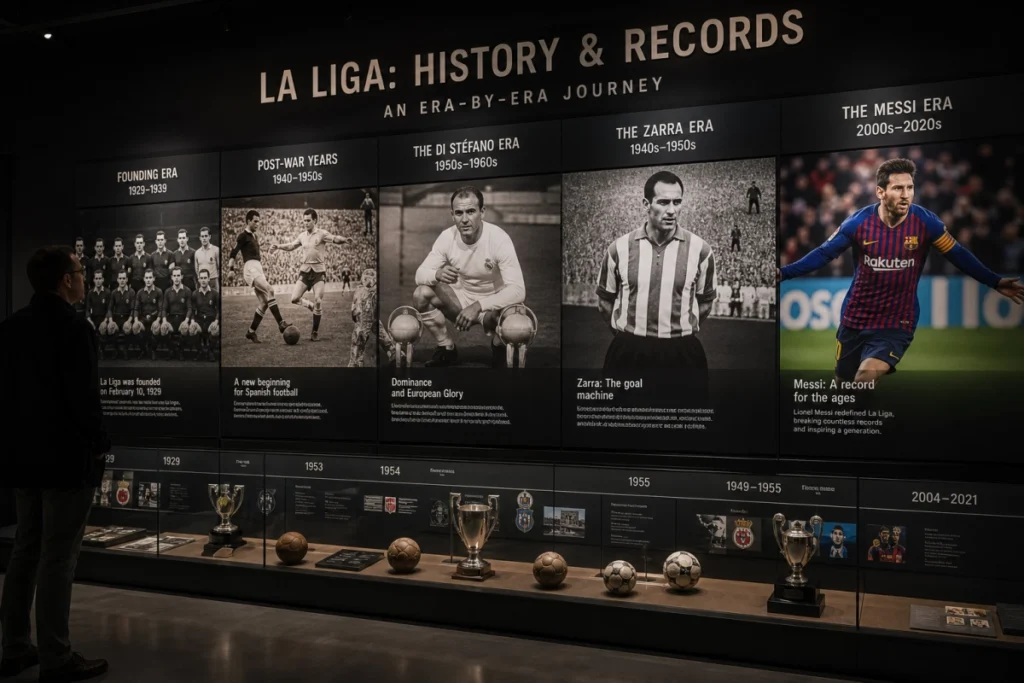
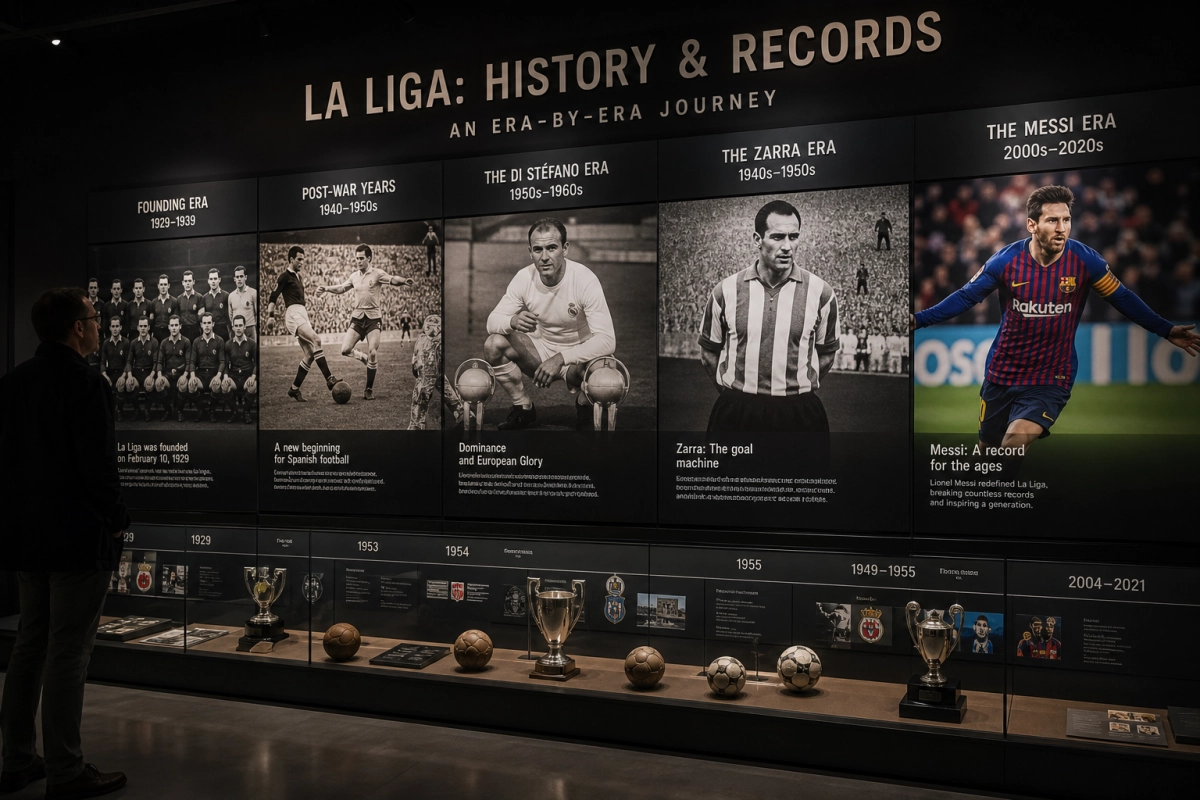
La Liga was created in 1929 as Spain’s national league, bringing together the country’s strongest regional sides into a single annual competition. The inaugural 1928–29 season produced the first league top scorer and introduced patterns of club dominance that would shape the records to come.
Paco Bienzobas — the first season’s marks
Paco Bienzobas (Real Sociedad) emerged as La Liga’s top scorer in the 1928–29 inaugural campaign. Playing as a central striker, Bienzobas combined close control and a calm finishing style that suited the lower-scoring tactical game of the era. His tally in that first season set the benchmark for a competition still finding its identity.
Why early scoring totals were modest
- Shorter schedules and different tactical approaches meant fewer goals per game.
- Pitch quality, travel and training methods were primitive compared to modern standards.
- These factors make early scoring leaders historically important, even if raw totals look small by today’s standards.
The Zarra era (1940s–1950s): longevity and the long-standing scoring record
Telmo Zarra (Athletic Bilbao) personified La Liga’s post-war golden-age striker. Across the 1940s and early 1950s he consistently finished among the league’s top scorers and collected multiple top-scorer awards — a period that cemented his name in the record books for decades.
How Zarra’s achievements became a long-term record
Zarra’s style combined aerial strength, quick finishing and positional intelligence well-suited to Athletic Bilbao’s attacking play. He set an all-time La Liga goals total that became the benchmark for future generations. Because substitutions, squad rotation and modern attacking systems were not yet in use, Zarra’s totals reflected relentless season-by-season consistency rather than one explosive campaign.
Key club context: Athletic Bilbao and the Basque tradition
Athletic Bilbao in this era relied on local talent and a simple, direct approach. That philosophy helped a homegrown striker like Zarra thrive; club stability and a focused role often produce long-term record-holders in league history.
Early modern milestone: the single-season landmark Lionel Messi set in 2011–12
One of La Liga history and records’ clearest modern reference points is Lionel Messi’s 2011–12 single-season league goal haul. Playing for FC Barcelona in a 38-match season, Messi scored 50 league goals — an unprecedented total for the contemporary, top-level era. That season’s achievement is a useful bridge from the mid-century scoring eras into the high-scoring modern game.
Messi in context
- Playing in an attack-focused Barcelona under Pep Guardiola and later under Tito Vilanova, Messi’s role combined finishing with playmaking.
- The 2011–12 season illustrated how tactical evolution, squad rotation and attacking support can push single-season totals to new levels.
Having traced La Liga’s origins, the first top scorers and how mid-century and early 21st-century milestones were created, the next section will examine the era of sustained club dominance, unbeaten runs and goalkeeper records from the 1960s through the 1990s, including exact dates and match details that set those benchmarks in La Liga history and records.
Real Madrid’s late-20th-century stranglehold: La Quinta del Buitre and five straight titles (1985–1990)
The middle-to-late 1980s belong to Real Madrid’s celebrated La Quinta del Buitre generation — Emilio Butragueño, Manuel Sanchís, Míchel, Martín Vázquez and Miguel Pardeza — a homegrown nucleus that delivered an unprecedented domestic run. Between the 1985–86 and 1989–90 seasons Real Madrid collected five consecutive La Liga crowns, a spell that reoriented the record books for sustained club dominance in the modern era.
How the streak was constructed: Real combined attacking firepower with tactical continuity under managers such as Luis Molowny and Leo Beenhakker. Butragueño’s late 1980s peak — notably his decisive performances in the 1986–87 and 1987–88 campaigns — gave the team a consistent match-winner. Spanish-born stars were supported by the arrival of Hugo Sánchez (signed in 1985), whose clinical finishing produced several Pichichi-winning seasons and helped secure critical late-season victories. The 1987–88 title, clinched during the spring run-in of 1988, is often cited as the moment the quintet’s dominance was undeniable: a squad built around homegrown cohesion rather than wholesale transfer-market overhauls.
Club profile: Real Madrid’s structure in this era—strong youth production, a clear tactical identity and few disruptive turnover seasons—explains why multi-year records crystallise here. The five-title streak set a template: sustained domestic supremacy need not come from constant star signings but from a stable core that outperforms rivals season after season.
Goalkeepers and shutouts: Abel Resino’s minutes and the rise of defensive records (1990–1991)
The 1990–91 season produced one of La Liga’s most enduring solitary records: Abel Resino’s run of consecutive minutes without conceding a league goal. Between late 1990 and spring 1991 Resino, Atlético Madrid’s goalkeeper, compiled a sequence that reached 1,275 minutes — the longest clean-sheet streak in La Liga history. The tally was sealed with a final clean sheet in April 1991, a run that included multiple high-pressure fixtures against title-chasers and established Atlético’s defence as one of the era’s most resolute.
Key match context: during the sequence Resino produced shutouts in fixtures where Atlético were under sustained attack, demonstrating not just individual reflexes but a defensive unit organised around central defenders such as José Luis Caminero’s era teammates and a disciplined midfield. That prolonged defensive excellence highlighted a broader tactical shift: while the 1980s rewarded attacking flair, the early 1990s also rewarded compact, systematised defending — and clean-sheet milestones became as celebrated as goal-scoring feats.
Player profile: Abel Resino’s record endures because it combined personal form, consistent team selection and match-by-match focus. It remains a benchmark for goalkeepers in La Liga: a reminder that the league’s record books commemorate not only spectacular goals but also long runs of near-impermeability between the posts.
The modern rivalry and the reshaping of benchmarks (1999–present)
Two careers that rewrote the scoring charts
The globalisation of La Liga and the arrival of two generational forwards altered the league’s statistical landscape. Lionel Messi’s Barcelona years produced the single-season landmark of 50 league goals (2011–12) and, across his La Liga career, the competition’s all-time goals record. Cristiano Ronaldo’s time at Real Madrid created a parallel run of extraordinary scoring consistency that pushed seasonal and cumulative tallies to new levels and sustained one of the most visible individual rivalries in football.
Playmaking, assists and new statistical focus
As scoring totals rose in some seasons, the measurement of assists and creative contribution became a formal part of record-keeping and analysis. Midfield architects and wide creators — aided by tactical shifts emphasizing possession and chance creation — established assist milestones that complement the league’s traditional goal and clean-sheet records.
Goalkeepers, longevity and specialist roles
Modern goalkeeper records evolved alongside changes in defensive patterns and training. Long clean-sheet streaks and seasonal shutout totals continued to attract attention, while the role of the goalkeeper expanded (playing out from the back, distribution accuracy), influencing how shutout records are achieved and appreciated.
Youth, age and the changing career arc
Recent decades have brought both younger debutants seizing first-team opportunities and veteran players extending productive careers through sports science and squad management. The pace at which youngest/oldest records are challenged reflects shifts in academy usage, transfer-market strategies and longevity in top-level football.
Looking forward: records as living history
Records in La Liga are not static trophies on a shelf but a running conversation between eras — a mix of individual brilliance, tactical evolution and club cultures that respond to changing times. They offer milestones to celebrate, targets to chase and stories that link past and present. As playing styles, technology and player movement continue to evolve, the league’s record book will keep acquiring new chapters; that ongoing change is part of what makes following these records compelling for fans, players and historians alike.