La Liga History and Records: Goals, Appearances and Club Dominance
La Liga history and records show how Spanish football evolved
La Liga history and records give you more than a list of famous names and large numbers. They show how attacking styles, club finances, tactical ideas and long-term consistency have shaped Spain’s top division. In this guide, you will learn about the leading goal scorers, players with the most appearances and clubs that have collected the most league titles.
La Liga began in the 1928–29 season, although its structure has changed over time. Earlier editions had fewer teams and fewer matches, while the modern competition normally features 20 clubs playing 38 league fixtures each. This difference matters when you compare players from different generations. A forward today may have more opportunities to score, while an older player’s achievement may have come across fewer matches and tougher playing conditions.
La Liga’s all-time top goal scorers
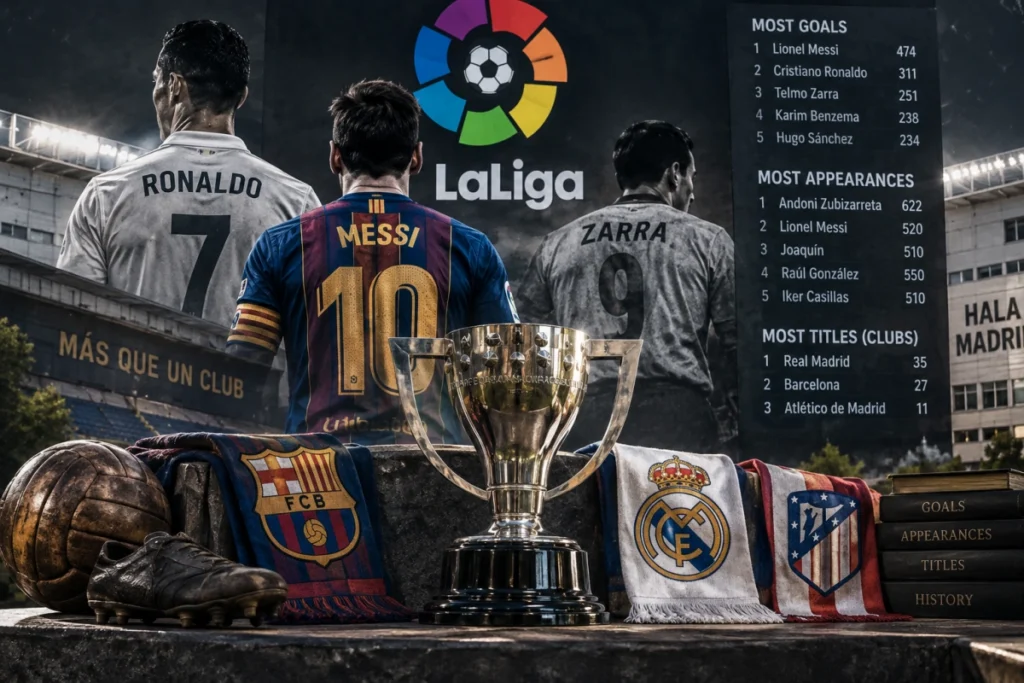
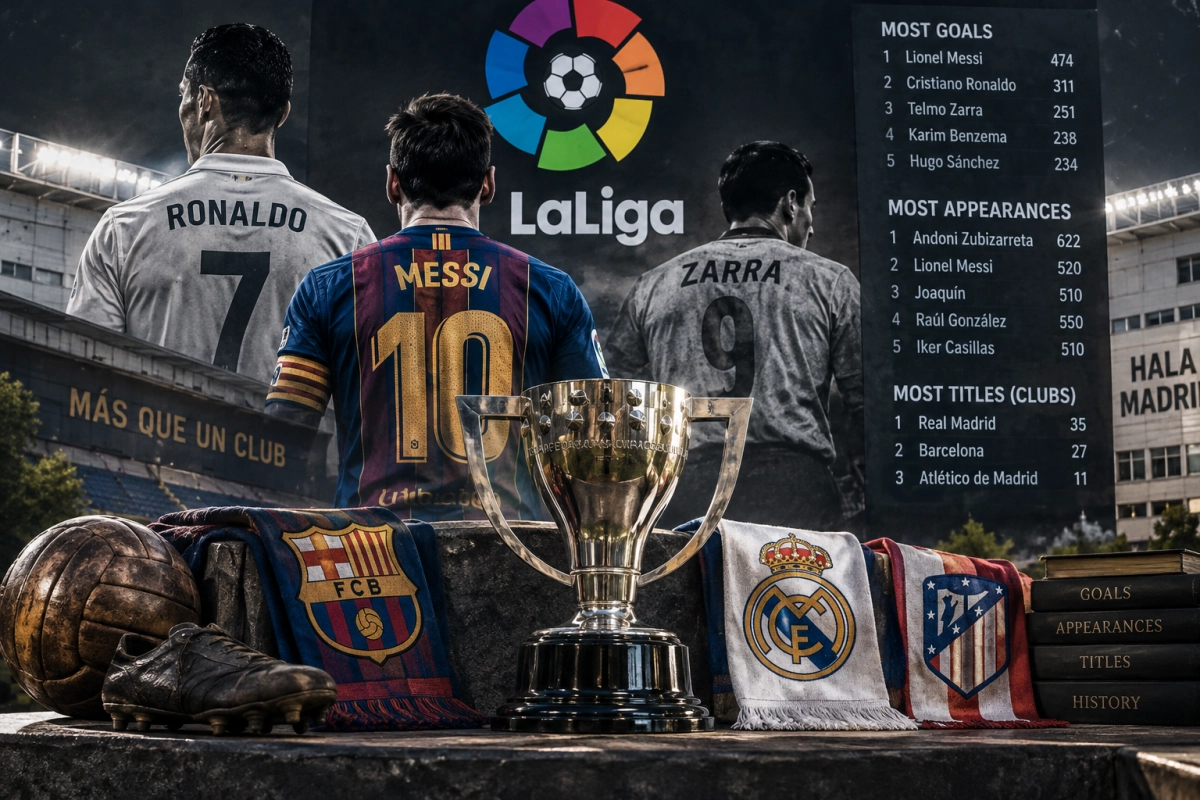
Lionel Messi remains the leading scorer in La Liga history, having scored 474 goals in 520 matches for Barcelona. His record combines exceptional finishing with creative responsibility. Messi was not only a penalty-box striker; he also regularly started attacks, created chances and influenced matches from wide or central positions.
- Lionel Messi: 474 goals
- Cristiano Ronaldo: 311 goals
- Karim Benzema: 238 goals
- Hugo Sánchez: 234 goals
- Raúl González: 228 goals
Cristiano Ronaldo’s total is particularly notable because he reached 311 goals in only 292 La Liga appearances for Real Madrid. His scoring rate reflected direct running, powerful movement inside the penalty area and outstanding aerial ability. Benzema, meanwhile, developed from a supporting forward into a complete attacking leader, helping Real Madrid compete for league titles while also contributing assists and link-up play.
Hugo Sánchez represents an earlier era of elite finishing. The Mexican striker won several Pichichi awards, the prize given to La Liga’s leading scorer, and became famous for movement around the six-yard box and acrobatic finishes. Raúl’s record reflects longevity and consistency: he scored across many seasons and remained an important figure during Real Madrid’s transition between generations.
Players with the most La Liga appearances
Appearance records measure durability as much as talent. To remain available for hundreds of league matches, a player must maintain fitness, adapt to different coaches and continue earning selection over many seasons.
Andoni Zubizarreta and Joaquín share the La Liga appearance record with 622 matches. Zubizarreta reached that figure as a goalkeeper for Athletic Club, Barcelona and Valencia. His career covered the 1980s and 1990s, when goalkeepers were often expected to focus more on positioning and shot-stopping than on building attacks.
Joaquín achieved the same total as a wide player, mainly with Real Betis, while also representing Valencia and Málaga. His record highlights a different kind of longevity: technical quality, pace and the ability to remain influential despite major changes in football’s physical and tactical demands.
These individual milestones connect closely with the next part of La Liga history and records: the clubs that converted sustained excellence into titles, unbeaten runs and historic scorelines.
Real Madrid’s title record reflects sustained dominance
Real Madrid have won more La Liga titles than any other club. Their total reached 36 championships after the 2023–24 season, placing them clearly ahead of Barcelona and Atlético Madrid. This record was built across several distinct periods rather than through one uninterrupted era of control.
Real Madrid’s early success established the club as a major force in Spanish football, while the 1950s and 1960s brought further domestic dominance alongside European achievement. The club also enjoyed a powerful run in the 1980s, when the team known as the Quinta del Buitre won five consecutive league titles from 1985–86 to 1989–90. More recently, championship-winning sides led by players such as Cristiano Ronaldo, Luka Modrić and Karim Benzema showed how elite recruitment could be combined with experienced leadership.
Barcelona are the closest challengers, with 28 La Liga titles. Their strongest modern period began under Johan Cruyff and continued through the possession-based teams of Pep Guardiola and later coaches. Atlético Madrid, with 11 titles, have provided an important alternative to the traditional Madrid–Barcelona rivalry, particularly under Diego Simeone. Their successes have demonstrated that defensive organisation, emotional intensity and efficient counter-attacking football can compete with clubs possessing greater financial resources.
Barcelona set the modern unbeaten-run benchmark
The longest unbeaten run in La Liga belongs to Barcelona, who went 43 league matches without defeat between April 2017 and May 2018. The sequence began near the end of the 2016–17 campaign and continued through the following season, when Barcelona won the title with a combination of attacking quality and remarkable consistency.
Lionel Messi was central to that achievement, but the run also depended on a balanced team. Luis Suárez provided goals and movement, Sergio Busquets controlled the midfield and defenders such as Gerard Piqué helped the side manage difficult matches. Barcelona eventually lost to Levante in a nine-goal thriller, but by then the unbeaten record had already surpassed the previous mark of 38 matches set by Real Sociedad between 1979 and 1980.
These records show why an unbeaten run requires more than a brilliant attack. A club must avoid injuries, respond to changes in form and collect points even when performances are less impressive. Over a full season, draws and narrow victories can be just as important as spectacular wins.
Historic scorelines reveal La Liga’s changing competitive landscape
The biggest victory in La Liga history came in 1931, when Athletic Club defeated Barcelona 12–1. Athletic’s forward Bata scored seven goals, a record for one player in a single La Liga match. The result belongs to an earlier period, when tactical systems were less compact and defensive organisation differed considerably from the modern game.
Large victories became less common as clubs improved their physical preparation, scouting and defensive structures. Even so, major scorelines continue to show how quickly a match can change when one side combines technical quality with confidence. They also provide historical context: a record set in the early decades of La Liga cannot be judged only by modern standards, because the number of teams, tactical conventions and competitive conditions were different.
Why La Liga’s records still matter
La Liga’s records remain valuable because they preserve the changing character of Spanish football. They reward brilliance, but also endurance, collective discipline and the ability to adapt as the competition evolves. Future players and clubs may surpass some of these marks, yet each new achievement will continue a conversation between different eras and different ideas about how the game should be played.