Greatest Premier League Moments: 10 Matches That Changed Football | Part 1
Why these Premier League matches still matter
The greatest Premier League moments are remembered for more than their final scores. They capture title races, record-breaking performances, dramatic comebacks and turning points that changed how clubs and players were viewed. In this historical feature, you will revisit ten unforgettable matches in chronological order and learn why their influence reached beyond one afternoon.
For football fans in Tanzania, East Africa and around the world, these matches also provide useful context when following Premier League scores, club rivalries and football results today. The first part begins with landmark games from the competition’s early years before moving into one of its most famous unbeaten campaigns.
Early records and the pressure of a title race
Manchester United 9-0 Ipswich Town — 4 March 1995
Manchester United’s 9-0 victory over Ipswich Town at Old Trafford remains one of the Premier League’s most remarkable individual and team performances. Andy Cole scored five goals, becoming the first player to reach that total in a Premier League match. His finishing showed the value of a striker who could attack space, combine with midfielders and remain calm in front of goal.
The result was also important in the 1994/95 title race. United were defending champions and needed a strong response during a competitive season. The nine-goal margin demonstrated their attacking power, although Blackburn Rovers eventually won the title by one point. For Ipswich, the defeat exposed the difference between a team competing near the bottom and a side built to challenge for trophies.
Blackburn Rovers 2-1 Liverpool — 14 May 1995
Blackburn’s final league match of the 1994/95 season became a landmark victory even though Liverpool won 2-1 at Ewood Park. Blackburn had built their campaign around a powerful partnership between Alan Shearer and Chris Sutton, but the title was decided through a tense combination of results on the final day.
Blackburn finished top because Manchester United could only draw 1-1 with West Ham United. That result ended United’s attempt to win a third consecutive Premier League title and gave Blackburn their first English top-flight championship since 1914. The match showed how football results can carry meaning beyond the stadium: a single point across a separate fixture changed the identity of the competition’s champion.
Comebacks and unbeaten history
Liverpool 4-3 Newcastle United — 3 April 1997
This Anfield classic is remembered for its relentless pace and late drama. Liverpool and Newcastle were both chasing European qualification, and neither defence could control the match. Goals from players including Robbie Fowler and Stan Collymore produced a seven-goal contest that appeared to be heading for a draw.
However, Liverpool scored a decisive late winner to complete a 4-3 victory. The result became one of the clearest examples of why the Premier League developed a reputation for open, unpredictable football. It also intensified the sense that Newcastle’s attacking team could entertain supporters while still falling short in high-pressure matches.
Tottenham Hotspur 2-2 Arsenal — 25 April 2004
Arsenal’s draw at White Hart Lane confirmed the club as Premier League champions during the 2003/04 season. More significantly, Arsène Wenger’s team completed the campaign unbeaten, becoming the first English top-flight side to achieve that feat since Preston North End in 1888/89.
The North London derby carried extra tension because Arsenal’s achievement was confirmed on Tottenham’s home ground. Arsenal’s control, defensive discipline and attacking quality had already shaped the season, but this result placed the team in football history. Next, the list moves to extraordinary title finishes, famous derbies and comebacks that transformed the Premier League era.
European stakes turn a title race into a classic
Chelsea 4-4 Liverpool — 14 April 2009
Chelsea’s 4-4 draw with Liverpool at Stamford Bridge was one of the Premier League’s most dramatic European nights. Liverpool arrived needing to overturn a 3-1 first-leg deficit in the Champions League quarter-final, but Chelsea quickly built a commanding advantage through goals from Didier Drogba and Alex.
Liverpool refused to accept defeat. Fabio Aurelio’s free-kick, a penalty from Xabi Alonso and further goals from Lucas Leiva and Dirk Kuyt briefly put the visitors ahead on away goals. Chelsea responded through Frank Lampard, whose late strikes completed an extraordinary draw. The result sent Chelsea through 7-5 on aggregate and showed how English clubs had become dominant forces in European competition. It also demonstrated that a match could be tactically intense while still producing the open drama associated with the Premier League.
Manchester’s balance of power changes in one afternoon
Manchester United 1-6 Manchester City — 23 October 2011
The Manchester derby at Old Trafford became a landmark victory for Manchester City and a warning to every established rival. United had won the Premier League title in 2010/11, while City were still building a team capable of challenging consistently. The scale of the result suggested that the competition’s traditional hierarchy was beginning to change.
Mario Balotelli scored twice before Jonny Evans was sent off, leaving United exposed against a City attack led by Sergio Agüero and Edin Džeko. City eventually scored six, with Džeko adding two late goals after United had briefly reduced the deficit. The defeat was United’s heaviest at home in the Premier League and gave City psychological momentum during their eventual title-winning season. Beyond the scoreline, the match became a symbol of a new rivalry based on genuine competition for trophies, influence and global attention.
A stoppage-time goal changes the meaning of a league title
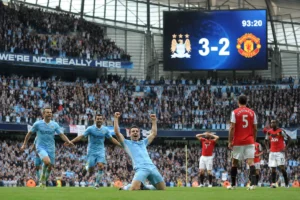
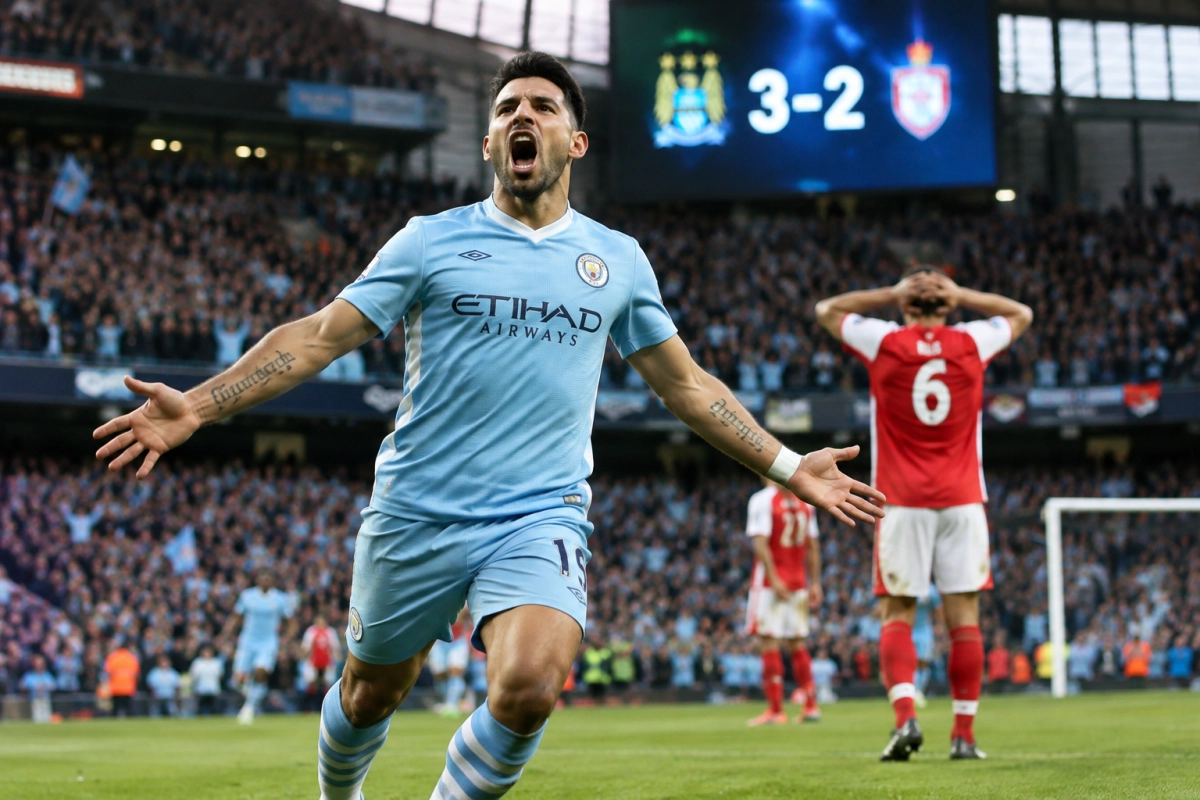
Manchester City 3-2 Queens Park Rangers — 13 May 2012
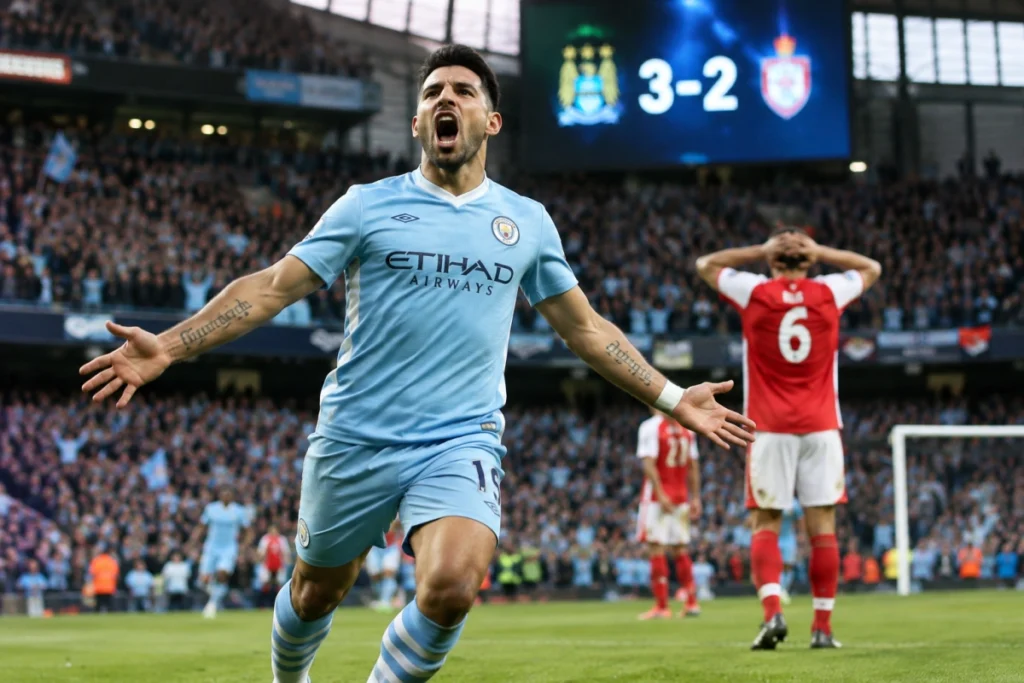
Manchester City’s final-day victory over Queens Park Rangers produced perhaps the most famous title-clinching finish in Premier League history. City needed to match Manchester United’s result, but QPR were fighting for survival and took a 2-1 lead at the Etihad Stadium despite having been reduced to ten men.
Edin Džeko equalised in the second minute of stoppage time, yet the title still appeared to be slipping away. Seconds later, Sergio Agüero collected Mario Balotelli’s pass and fired the winning goal into the corner. The 3-2 victory gave City their first league title since 1968 on goal difference, while United’s win at Sunderland became irrelevant. Agüero’s celebration entered football history, and the match showed how one final attack can transform a club’s identity, a rivalry and the entire narrative of a season.
New champions and changing ambitions
Chelsea 2-2 Tottenham Hotspur — 2 May 2016
The Battle of Stamford Bridge became one of the defining matches of Leicester City’s extraordinary 2015/16 title campaign. Tottenham needed to win to maintain a mathematical chance of catching Leicester, but Chelsea’s equaliser ensured that their London rivals could no longer overtake the leaders.
The match ended in a mass confrontation, with Tottenham receiving nine yellow cards and Chelsea collecting three. Beyond the heated derby atmosphere, the result confirmed Leicester as champions and completed one of the greatest sporting transformations in English football. A club that had narrowly avoided relegation two seasons earlier had now surpassed the country’s richest and most established teams.
Manchester City 2-3 Manchester United — 7 April 2018
Manchester City appeared ready to celebrate the Premier League title against Manchester United after building a 2-0 half-time lead at the Etihad Stadium. However, Paul Pogba scored twice in quick succession after the interval, before Chris Smalling completed United’s comeback.
The victory delayed City’s title confirmation and gave United one of the most memorable derby wins of the modern era. It also showed that even a dominant team could be unsettled by a sudden change in momentum. City eventually secured the championship, but the match remains a reminder that local pride can give a fixture significance beyond its place in the table.
Manchester City 3-2 Aston Villa — 22 May 2022
Manchester City’s final-day victory over Aston Villa produced another extraordinary title finish. City trailed 2-0 with less than 15 minutes remaining, while Liverpool were simultaneously defeating Wolverhampton Wanderers and threatening to take first place.
Three goals in five minutes, including a late winner from İlkay Gündoğan, turned the match around and secured City’s fourth Premier League title in five seasons. The comeback demonstrated the importance of squad depth, resilience and belief under extreme pressure. It also reinforced the competitive standard created by the modern rivalry between Manchester City and Liverpool.
The moments that keep defining the Premier League
The Premier League’s most enduring matches remain powerful because they connect sporting quality with human emotion. They remind supporters that dominance can disappear in seconds, that an overlooked club can challenge the established order and that a single goal can alter the meaning of an entire season.
Years later, these occasions continue to shape club identities and supporter memories. Their influence is found not only in record books, but also in the rivalries, expectations and belief that make every new Premier League campaign worth following.