La Liga history and records: a chronological guide from 1929
La Liga history and records: a chronological guide from 1929
What this guide covers about La Liga history and records
This article traces La Liga history and records from the league’s 1929 founding to the present. Readers will get a clear, date-driven chronology of landmark seasons, the league’s interruptions, and the early winners and formats. Later parts of the guide will list major records (most titles, top scorers, most appearances, longest unbeaten runs, biggest wins and youngest/oldest scorers) and a dedicated section on African players’ achievements in Spain. The overview here sets the stage by explaining how La Liga began and how the competition evolved through its first decades.
Founding and the inaugural season (1928–29): dates and first champion
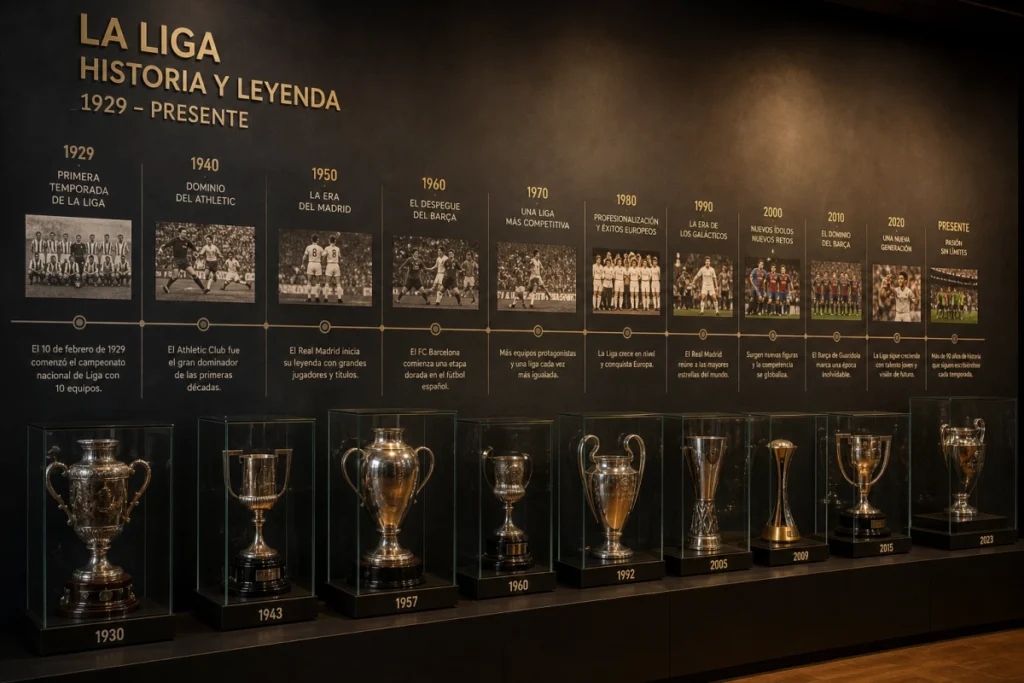
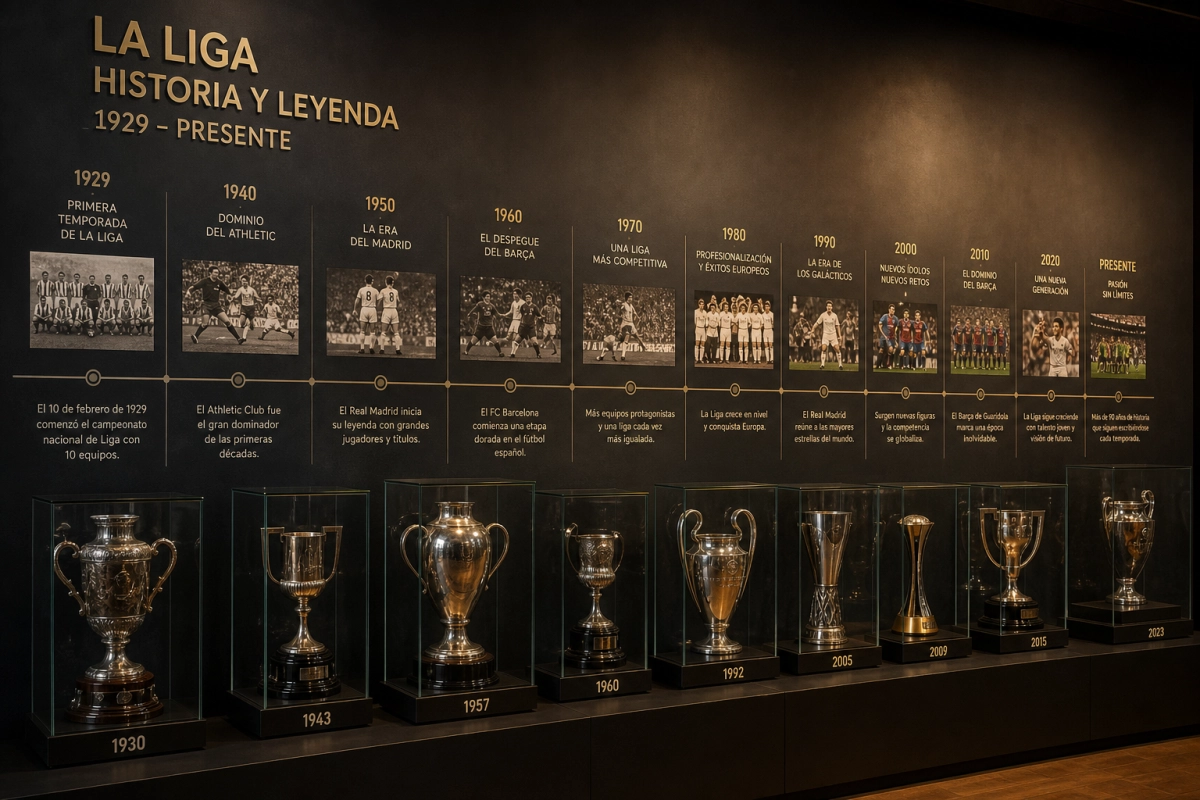
La Liga began as Spain’s first national league competition in 1929. The inaugural competition is officially recorded as the 1928–29 season because teams qualified through earlier regional championships; league play itself started in early 1929.
Key dates and the first matches
- League kickoff: first round of La Liga fixtures took place on 10 February 1929.
- Inaugural season timeframe: the 1928–29 season ran through the spring and early summer of 1929, concluding in June 1929.
- First champion: FC Barcelona won the first La Liga title in that 1928–29 campaign.
Ten clubs contested that inaugural season, drawn from Spain’s strongest regional sides. The new national format replaced a purely regional approach and created a single table where the champion would be determined by consistent league results rather than knockout cups alone.
Early development: the 1930s and the Civil War interruption (1929–1939)
La Liga quickly established club rivalries and produced early dominant teams. Athletic Bilbao, Real Madrid and Barcelona were prominent in the 1930s as the league matured tactically and organizationally.
Wartime suspension and resumption
- Spanish Civil War impact: the competition was suspended between 1936 and 1939 due to the Spanish Civil War; no official La Liga seasons were held during those years.
- Post-war restart: national league football resumed for the 1939–40 season as clubs and stadiums recovered from the wartime disruption.
The wartime break was the first major interruption in La Liga’s history and had a lasting impact on club finances, player careers and regional power balances within Spanish football. The post-1939 seasons saw reorganised competitions and new administrative rules as the league rebuilt.
Why the early years matter for La Liga records
The 1929 founding and the 1936–39 suspension set patterns that shaped later records: early champions built title legacies, long gaps affected appearance and scoring totals for a generation of players, and the return to full competition after 1939 created the modern era for many longstanding La Liga records.
Part 2 will follow the league through its mid‑century growth, the rise of long-term powerhouses, and the origin points of many all-time records.
Post‑war consolidation and the 1940s: rebuilding the national competition
After the Civil War suspension, La Liga returned for the 1939–40 season and the 1940s became a decade of reconstruction rather than radical change. Clubs reassembled squads, repaired stadiums and re-established regional scouting networks; the league calendar settled back into an autumn–spring rhythm that would become standard for decades. Economically and logistically the Spanish game was still constrained, but competition resumed quickly: promoted and relegated clubs moved through the pyramid as before, and the pre‑war elite — Athletic Bilbao, Barcelona and Real Madrid — reasserted themselves alongside emerging provincial powers.
Key structural developments of this period set the scene for later records. Attendances grew as stadiums reopened and were expanded; club presidents invested in training and younger players; and the first post‑war generation of professionals began compiling long‑term appearance and scoring totals that later record lists would reference. Though few headline statistical records were established outright in the 1940s, the decade established continuity and club infrastructures which allowed large career totals (appearances, goals) to accumulate from the 1950s onward.
The Bernabéu era and Real Madrid’s European breakthrough (1947–1960)
The late 1940s and 1950s mark the clearest origin point for many La Liga and continental records. A tangible milestone was the opening of Real Madrid’s new stadium on 14 December 1947 (the Nuevo Estadio Chamartín, later renamed Santiago Bernabéu), a symbol of club modernisation that coincided with ambitious transfers and investment.
The signing of Alfredo Di Stéfano in 1953 transformed Real Madrid’s fortunes and, by extension, the record books. Once UEFA launched the European Cup, Real Madrid dominated the competition: the inaugural 1955–56 European Cup campaign culminated in a high‑scoring final on 13 June 1956, and Real went on to win five consecutive European Cups between 1955–56 and 1959–60. The era’s climax came in the 1959–60 final, a celebrated 7–3 victory on 18 May 1960. Those continental triumphs elevated La Liga’s profile internationally and produced career records — prolific goal tallies, repeated domestic titles and multiple continental winners’ medals — that have remained reference points ever since.
Individuals from this period forged lasting statistical marks. Alfredo Di Stéfano’s scoring feats in domestic and continental competition created durable standards for forwards; Francisco Gento’s presence across Real’s six European Cup wins established a record for continental titles that endures as an outlier in career honours. Equally, the professional stability and higher match volumes of the 1950s allowed players to start compiling season‑by‑season totals that later generations would chase.
Tactical maturity and the roots of long‑running records (1960s–1970s)
The 1960s and 1970s were years of tactical evolution and institutional consolidation that set up many modern La Liga records. Clubs professionalised further: coaching methods modernised, youth systems became systematic feeder channels and the league calendar expanded in intensity. The Real–Barcelona rivalry deepened into a sustained contest for domestic supremacy, while teams such as Atlético Madrid and Valencia periodically challenged for titles, creating contested championship runs that produced memorable unbeaten sequences, high individual goal totals and extended careers.
Statistically, this era produced the beginnings of many long‑running records — players beginning careers who would later top appearance charts, forwards whose seasonal goal hauls presaged all‑time scoring lists, and clubs whose repeated successes laid the foundation for “most titles” records. Changes in match scheduling, the steady increase in fixture numbers and improved club organisation meant that records became not only a matter of single seasons but of multi‑decade accumulation. These trends carried La Liga into the modern, media‑driven era that Part 3 will examine in detail.
La Liga history and records: a chronological guide from 1929
What this guide covers about La Liga history and records
This article traces La Liga history and records from the league’s 1929 founding to the present. Readers will get a clear, date-driven chronology of landmark seasons, the league’s interruptions, and the early winners and formats. Later parts of the guide will list major records (most titles, top scorers, most appearances, longest unbeaten runs, biggest wins and youngest/oldest scorers) and a dedicated section on African players’ achievements in Spain. The overview here sets the stage by explaining how La Liga began and how the competition evolved through its first decades.
Founding and the inaugural season (1928–29): dates and first champion
La Liga began as Spain’s first national league competition in 1929. The inaugural competition is officially recorded as the 1928–29 season because teams qualified through earlier regional championships; league play itself started in early 1929.
Key dates and the first matches
- League kickoff: first round of La Liga fixtures took place on 10 February 1929.
- Inaugural season timeframe: the 1928–29 season ran through the spring and early summer of 1929, concluding in June 1929.
- First champion: FC Barcelona won the first La Liga title in that 1928–29 campaign.
Ten clubs contested that inaugural season, drawn from Spain’s strongest regional sides. The new national format replaced a purely regional approach and created a single table where the champion would be determined by consistent league results rather than knockout cups alone.
Early development: the 1930s and the Civil War interruption (1929–1939)
La Liga quickly established club rivalries and produced early dominant teams. Athletic Bilbao, Real Madrid and Barcelona were prominent in the 1930s as the league matured tactically and organizationally.
Wartime suspension and resumption
- Spanish Civil War impact: the competition was suspended between 1936 and 1939 due to the Spanish Civil War; no official La Liga seasons were held during those years.
- Post-war restart: national league football resumed for the 1939–40 season as clubs and stadiums recovered from the wartime disruption.
The wartime break was the first major interruption in La Liga’s history and had a lasting impact on club finances, player careers and regional power balances within Spanish football. The post-1939 seasons saw reorganised competitions and new administrative rules as the league rebuilt.
Why the early years matter for La Liga records
The 1929 founding and the 1936–39 suspension set patterns that shaped later records: early champions built title legacies, long gaps affected appearance and scoring totals for a generation of players, and the return to full competition after 1939 created the modern era for many longstanding La Liga records.
Part 2 will follow the league through its mid‑century growth, the rise of long-term powerhouses, and the origin points of many all-time records.
Post‑war consolidation and the 1940s: rebuilding the national competition
After the Civil War suspension, La Liga returned for the 1939–40 season and the 1940s became a decade of reconstruction rather than radical change. Clubs reassembled squads, repaired stadiums and re-established regional scouting networks; the league calendar settled back into an autumn–spring rhythm that would become standard for decades. Economically and logistically the Spanish game was still constrained, but competition resumed quickly: promoted and relegated clubs moved through the pyramid as before, and the pre‑war elite — Athletic Bilbao, Barcelona and Real Madrid — reasserted themselves alongside emerging provincial powers.
Key structural developments of this period set the scene for later records. Attendances grew as stadiums reopened and were expanded; club presidents invested in training and younger players; and the first post‑war generation of professionals began compiling long‑term appearance and scoring totals that later record lists would reference. Though few headline statistical records were established outright in the 1940s, the decade established continuity and club infrastructures which allowed large career totals (appearances, goals) to accumulate from the 1950s onward.
The Bernabéu era and Real Madrid’s European breakthrough (1947–1960)
The late 1940s and 1950s mark the clearest origin point for many La Liga and continental records. A tangible milestone was the opening of Real Madrid’s new stadium on 14 December 1947 (the Nuevo Estadio Chamartín, later renamed Santiago Bernabéu), a symbol of club modernisation that coincided with ambitious transfers and investment.
The signing of Alfredo Di Stéfano in 1953 transformed Real Madrid’s fortunes and, by extension, the record books. Once UEFA launched the European Cup, Real Madrid dominated the competition: the inaugural 1955–56 European Cup campaign culminated in a high‑scoring final on 13 June 1956, and Real went on to win five consecutive European Cups between 1955–56 and 1959–60. The era’s climax came in the 1959–60 final, a celebrated 7–3 victory on 18 May 1960. Those continental triumphs elevated La Liga’s profile internationally and produced career records — prolific goal tallies, repeated domestic titles and multiple continental winners’ medals — that have remained reference points ever since.
Individuals from this period forged lasting statistical marks. Alfredo Di Stéfano’s scoring feats in domestic and continental competition created durable standards for forwards; Francisco Gento’s presence across Real’s six European Cup wins established a record for continental titles that endures as an outlier in career honours. Equally, the professional stability and higher match volumes of the 1950s allowed players to start compiling season‑by‑season totals that later generations would chase.
Tactical maturity and the roots of long‑running records (1960s–1970s)
The 1960s and 1970s were years of tactical evolution and institutional consolidation that set up many modern La Liga records. Clubs professionalised further: coaching methods modernised, youth systems became systematic feeder channels and the league calendar expanded in intensity. The Real–Barcelona rivalry deepened into a sustained contest for domestic supremacy, while teams such as Atlético Madrid and Valencia periodically challenged for titles, creating contested championship runs that produced memorable unbeaten sequences, high individual goal totals and extended careers.
Statistically, this era produced the beginnings of many long‑running records — players beginning careers who would later top appearance charts, forwards whose seasonal goal hauls presaged all‑time scoring lists, and clubs whose repeated successes laid the foundation for “most titles” records. Changes in match scheduling, the steady increase in fixture numbers and improved club organisation meant that records became not only a matter of single seasons but of multi‑decade accumulation. These trends carried La Liga into the modern, media‑driven era that Part 3 will examine in detail.
Modern era: globalisation, Bosman and the superstars (1980s–present)
From the 1980s onward La Liga entered a distinct modern phase driven by television revenues, commercial sponsorship and regulatory change. The 1995 Bosman ruling accelerated cross‑border movement of players, prompting clubs to recruit more international talent while also investing heavily in youth development and scouting. Growing broadcast income in the 1990s and 2000s gave Spanish clubs the financial firepower to record transfer and wage milestones, and the emergence of globally recognised superstars changed single‑season and career benchmarks: Lionel Messi and Cristiano Ronaldo rewrote scoring records and appearance milestones in the 2000s–2010s, while Real Madrid and Barcelona compiled trophy hauls that shifted the “most titles” conversation. Advances in sports science, analytics and fixture management extended player longevity and increased the intensity of competition, producing new kinds of records (assists, expected goals–based metrics, consecutive appearances). The modern era also widened La Liga’s international footprint, creating off‑field records in revenue, viewership and merchandising that indirectly influenced on‑pitch achievements. These structural changes created a clear divide between early decades and the contemporary record landscape; later sections will catalogue the headline statistical records, contextualise era effects and include a focused study of African players’ contributions to Spanish football.
Key modern milestones
- 1995: Bosman ruling enables freer movement of players across Europe.
- Late 1990s–2000s: major TV deals expand club revenues and global reach.
- 2000s: La Masia and youth development produce a generation of homegrown stars.
- 2004–2018: Messi and Ronaldo era, with multiple single‑season and career scoring records.
- 2009 onwards: Real and Barcelona dominate continental and domestic honours in alternating phases.
- 2010s–2020s: analytics, sports science and commercial growth reshape player longevity and transfer market records.
Part 3 will present detailed statistical lists (top scorers, most appearances, biggest wins, unbeaten runs and notable age records) and a dedicated analysis of African players’ impact on La Liga history and records.