How the World Cup 2026 Draw Affects Qualified Teams & Groups


How the 2026 draw reshapes your team’s path to the knockout rounds
The 2026 World Cup draw isn’t just a ceremonial event — it’s the moment your team discovers the short-term roadmap of opponents, travel demands and tactical choices that will determine whether you reach the knockout rounds. With an expanded 48-team tournament and multiple host nations, the draw has new mechanics and consequences you need to understand if you’re following or preparing a qualified nation.
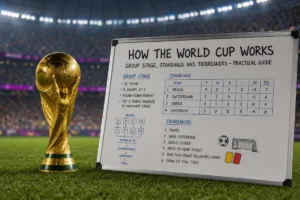
At its core, the draw sets the groups, fixes match order and creates the early competitive landscape. Because the 2026 format reduces group sizes and changes how many teams advance from each group, every placement can dramatically affect qualification probability. You’ll want to know where your team sits in the draw order, which pot it came from, and which confederation restrictions apply — all of which directly influence the strength of the opponents you’ll face and the strategic approach your coach might adopt.
Seeding, pots and confederation rules: practical effects on groups
How seeding and pots determine likely opponents
The draw uses seeded pots to distribute teams and avoid stacking a single group with multiple top-ranked sides. Seeding is typically based on FIFA rankings, past performances and special allocations for host nations, so your team’s ranking before the draw will affect which pot you’re placed in. Being in a higher pot usually means you avoid other top teams in the same group, while a lower pot can leave you facing stronger opponents early.
- Pot placement changes the range of potential opponents rather than naming specific rivals — your matchups depend on how the other pots fill out.
- If your team is a host or automatically qualified, you may be placed into a designated group, altering competitive balance across groups.
- For coaches and analysts, pot assignments guide tactical preparation: conservative game plans versus high-risk aiming for wins.
Confederation protections and geographic balancing
The draw enforces confederation-based rules designed to spread teams from the same region across different groups. These protections prevent multiple teams from the same confederation clustering together and ensure broader global representation in each group. However, exceptions are common — for example, Europe usually has a higher limit of teams per group because of its large quota — and that affects the likelihood you’ll face a regional rival in the group stage.
- Geographic rules reduce the chance of early regional matchups, which can be important if you prefer to avoid familiar styles of play.
- When multiple hosts are involved, their automatic placements and travel logistics can push other teams into groups with longer journeys or compressed schedules.
- Understanding these constraints helps you anticipate which pots are likeliest to produce the stiffest competition in your group.
With these basics covered — seeding, pots and confederation rules — you can start to evaluate how favorable or difficult a draw might be for your team. In the next section you’ll examine how the three-team groups, scheduling, and tiebreaker rules change match strategy and what to watch for on draw night.
How three-team groups and match order force different match strategies
The shift to 16 groups of three — with only two group games per team — changes coaching calculations at a fundamental level. With fewer minutes to secure points, each match carries more weight; a single loss or draw can be far more punitive than in a four-team group where there’s a third opportunity to recover.
Practical consequences for match strategy:
– Every game becomes nearer to a knockout fixture. Coaches are likelier to prioritize getting a win in the opening game rather than cushioning for later matches, because the margin for error is tiny.
– Goal margin matters more. With ties on points far more likely across a two-match sample, goal difference and goals scored can be decisive; teams that only aim to scrape 1–0 wins risk being overtaken by more proactive sides.
– Risk management changes by match order. If your team plays first, the priority is to avoid falling behind on goal difference; if you play second you may know exactly what result suffices, but that knowledge also creates incentives for the opponent and creates potential for engineered outcomes.
– Squad rotation calculus tightens. With one fewer group match there’s less room to rest key players without jeopardizing results, but the condensed schedule and travel (see next section) may still force rotations. Depth and fitness planning become central.
One inevitable concern with three-team groups is the inability to have simultaneous final group matches — a natural check against collusion in four-team formats. That increases the theoretical risk of strategic, mutually beneficial results in the last pairing. Coaches must therefore prepare contingency plans for late-match scenarios, both to exploit known targets and to guard against being manipulated by another team’s result.
Scheduling, travel logistics and tiebreaker pressure: what to watch on draw night
On draw night, aside from who you get in your group, pay attention to the match order, stadium allocations and likely host cities. The 2026 tournament spans the U.S., Canada and Mexico, so travel distances between two group matches can be substantial — and that affects recovery, training access and acclimatization.
Logistical factors to evaluate immediately after the draw:
– Match order and home-country slots: which of your two matches comes first, and where will they be played? Early long-haul travel between venues can sap energy and disrupt preparations.
– Rest days between your two games: short turnarounds favor deeper squads and teams with superior recovery protocols.
– Climate and altitude differences: playing in different host nations or vastly different regions (humid coastal cities vs high-altitude venues) within a short window changes selection and substitution strategies.
Tiebreaker realities
With only two matches, ties on points — and even on goal difference and goals scored — become more common. Familiar FIFA tiebreakers (points, goal difference, goals scored, head-to-head metrics, fair play and finally drawing of lots) mean teams must plan for many micro-decisions:
– Push for an extra goal when the opportunity arises; one additional strike can separate qualifiers from eliminations.
– Manage disciplinary risk: yellow cards may end up as a tie-breaking factor, so timing of tactical fouls and card-prone players matter.
– Prepare for head-to-head nuances: because there are only two opponents, head-to-head rules can swing outcomes; know whether direct results trump goal difference in the tournament regulations and plan accordingly.
On draw night, then, don’t just note your opponents — map the logistics, check the match order and project simple tiebreaker scenarios. Those small details will dictate whether your team adopts a conservative defensive plan or chases emphatic wins from the outset.
After the draw: immediate steps for teams and fans
The draw is the trigger for action — not an endpoint. Whether you represent a team, staff, media outlet or are planning to follow live, use the hours and days after the draw to convert its outcomes into concrete plans.
For teams and coaches
- Finalize travel and accommodation plans to minimize fatigue and logistical risk between your two group matches.
- Run rapid opponent scouting sessions focused on the specific match order and likely scenarios (e.g., whether an all‑out win or controlled draw is required).
- Adjust training loads and rotation plans to match rest-day windows and any climate/altitude differences in assigned venues.
- Simulate tiebreaker scenarios with players so everyone understands how goals, cards and head‑to‑head results affect qualification.
- Confirm administrative details — accreditation, medical contingencies and recovery protocols — tied to the host-city allocations revealed by the draw.
For fans, federations and media
- Lock in travel and ticketing early; multi-host travel can create complex itineraries that sell out quickly.
- Plan for match-day logistics (stadium access, local transport, accommodation proximity) and consider contingency plans for tight turnarounds.
- Coordinate with broadcasters and digital teams to highlight key storylines created by match order, potential tiebreakers and travel narratives.
- Monitor official channels for schedule confirmations and any draw-related clarifications: consult the official FIFA draw page for updates.
Use the draw as a practical checklist rather than a moment of celebration: act quickly on logistics, sharpen tactical plans around the match order, and prepare players and supporters for the unique pressures of the 2026 format. The teams that move fastest from draw to execution give themselves the best chance of turning group placement into progress.