Football Betting Odds Comparison: Live Lines, Bookmakers & Tips

How live football odds shape your in-play betting choices
When you’re watching a match, odds change constantly. Live lines reflect evolving information—goals, red cards, injuries, possession shifts, and how the market reacts. Understanding how bookmakers adjust prices in-play helps you identify moments when odds misprice risk or opportunity. If you learn to read those movements, you can decide whether to take a bet, hedge an existing position, or wait for a better price.
What “live” odds represent and why they move
- Real-time events: Every on-field event has an immediate impact. A goal or sending-off typically produces the largest, fastest swings in price.
- In-running data feeds: Bookmakers and trading desks receive match data and use it to re-weight probabilities via automated models and trader oversight.
- Market liquidity and stake distribution: Heavy money on one outcome will push the price away from that option to limit exposure. Low liquidity markets (lower leagues, niche props) can exhibit wild swings.
- Latency and regional differences: Odds can differ slightly between bookmakers and apps because of feed delays or different model parameters—this is where arbitrage and line shopping opportunities appear.
How to compare bookmakers efficiently and find real value
Line shopping is one of the simplest, most effective habits you can adopt. You should never assume all bookies offer the same price—small differences in decimal odds translate to meaningful changes in long-term return. Use odds comparison tools or set up a short list of trusted bookmakers to check quickly before staking.
Practical checklist for comparing odds and markets
- Compare the same market across providers: Match odds, over/under, both teams to score, and popular player props. Focus on markets you understand best.
- Convert odds to implied probability: Decimal odds → implied probability = 1 / odds. This helps you see how much margin the bookmaker has built in.
- Calculate bookmaker margin (overround): Sum the implied probabilities for all mutually exclusive outcomes and subtract 1. Lower margin = more favourable prices.
- Monitor live line shifts: Track how quickly odds move after key events. Slow movement can indicate a lagging market; too-fast movement may reflect large liabilities being protected.
- Use multiple accounts: Having access to several reputable bookmakers lets you snap up the best available price in seconds.
Beyond raw odds, you should weigh other factors like welcome offers, bet limits, cash-out policies, and the reliability of in-play feeds—these affect both your effective value and risk management. With these foundations in place, you can start looking for systematic edges and build a routine for comparing live lines quickly and confidently.
Next, you’ll learn concrete methods to calculate value bets in real time, set up alerts and tools to catch shifting lines, and apply practical staking strategies when using multiple bookmakers.
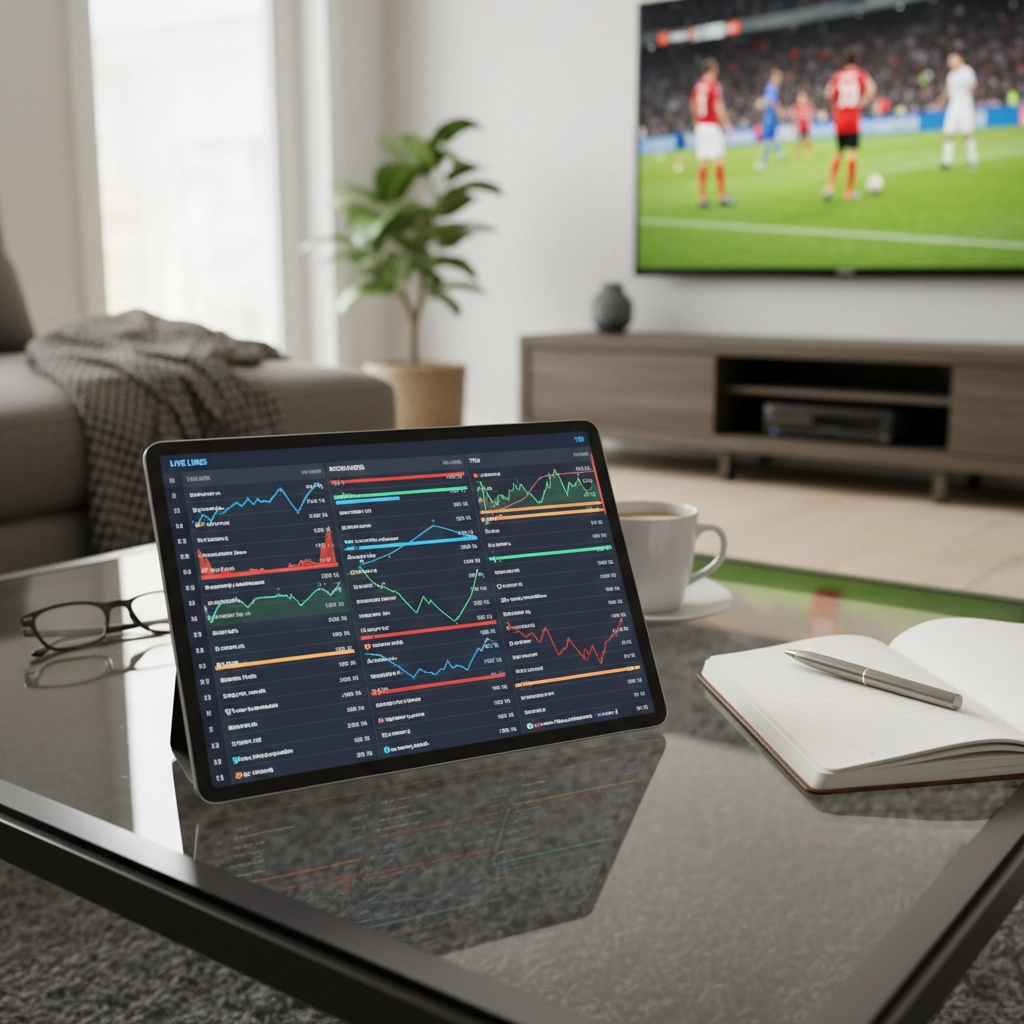
Calculating in-play value: a quick, repeatable method
Finding value in-running is about comparing the bookmaker’s implied probability with your own updated estimate of an outcome. Do it fast and consistently with a simple three-step process you can repeat every time the odds change.
- Step 1 — Convert odds to implied probability: For decimal odds, implied probability = 1 / odds. If a home win is 2.25, implied probability = 1 / 2.25 ≈ 44.4%.
- Step 2 — Adjust your subjective probability for context: Start from pre-match models or expectations, then modify for live factors: time elapsed, current score, red cards, possession and clear-cut chances. For speed, use preset adjustments: e.g. a red card for the favorite = +10–20% swing in opponent’s probability depending on time remaining; a 1–0 lead at halftime reduces the conceded goal expectation by X% (calibrate X from your pre-match model).
- Step 3 — Compare and quantify edge: Edge (%) = (Your probability — Implied probability) / Implied probability. If your updated estimate for the home win is 55% and the bookie shows 44.4%, edge ≈ (0.55 − 0.444) / 0.444 ≈ 24%. Set a minimum edge threshold (for example 8–12%) to avoid noise and transaction costs.
Practical examples speed learning. If a favorite concedes and you increase the underdog’s chance from 35% to 50% but the market moves to only 40%, that’s a clear signal. Likewise, factor in bookmaker margin — if the market has a high overround in niche props, boost your required edge to compensate.
Tools, alerts and workflows to capture shifting lines
Speed and automation separate casual bettors from consistent line shoppers. Build a workflow that minimizes manual checks while keeping you informed of genuine opportunities.
- Odds comparison services: Use sites or apps that aggregate pre-match and in-play odds across bookmakers. Configure favourites list and markets so you see disparities instantly.
- Custom alerts and filters: Set alerts for percentage moves (e.g. >15% swing), line crosses (odds fall below/above a threshold), or liquidity events. Many providers offer mobile push or email alerts; combine these with your watchlist for fast reactions.
- Trading tools and spreadsheets: Maintain a simple dashboard: market odds, implied probability, your model probability, and suggested stake per your staking rule. Google Sheets or lightweight desktop apps can auto-fetch odds via APIs or web-scraping add-ons.
- Latency and control checks: Compare two fast feeds (e.g. a sportsbook app and an exchange like Betfair) to detect lag. If a bookmaker consistently lags, use it for arbitrage or last-second snaps — but beware of cancelations or limits.
- Practice and simulation: Run demo sessions where you mark value opportunities without betting. This conditions quick judgment and trains your presets for adjustments (red card, injury, tactical change).
Practical staking when you spread bets across multiple bookmakers
Using several accounts widens your priced opportunities but complicates staking. Combine conservative sizing with edge-based scaling to protect your bankroll and capture value.
- Flat-percent staking: Stake a fixed percentage of bankroll on each qualifying bet (commonly 1–2%). Simple, limits downside and works well when edges are modest.
- Fractional Kelly: Use Kelly for mathematically optimal sizing, but apply a fraction (e.g. 20–50%) to reduce variance. Calculate stakes from your estimated edge and bookie odds.
- Split stakes across books: When capturing a best price on the same bet across books, place the full stake where the price is best. If you hedge or ladder (staggered stakes as odds shift), record the combined exposure in your dashboard.
- Limits and liquidity management: If a book limits you, scale down and redirect remaining stake to other providers or to exchanges. Track maximum match exposure to avoid oversizing across correlated markets.
- Protective cash-out and hedging: For significant in-running winners, consider partial cash-out or laying off a portion on an exchange to lock profit and reduce variance.
Quick operational checklist
- Preconfigure a shortlist of markets and teams to monitor so alerts are relevant and fast.
- Keep a live dashboard (sheet or app) that shows market odds, implied probability and your model probability for instant edge calculation.
- Set clear edge and stake thresholds before you act (e.g. minimum 8–12% edge; 1–2% bankroll flat stake or fractional Kelly).
- Practice in demo mode or with tiny stakes to sharpen reaction times and presets for common live events (red cards, injuries, momentum swings).
- Rotate liquidity: use exchanges when books are limiting and compare feeds to detect latency opportunities.
Putting the approach into action
Value hunting and line comparison are skills you build, not one-off hacks. Start with disciplined record-keeping, limit the number of live markets you follow, and refine your presets for the most common game-state changes. Use reliable odds-aggregation tools like OddsPortal to spot discrepancies quickly, but always validate with your own probability adjustments before committing capital. Over time the combination of fast workflows, conservative staking and focused practice will separate noise from repeatable edges.
Frequently Asked Questions
How do I quickly convert decimal odds into implied probability during a match?
Divide 1 by the decimal odds (implied probability = 1 / odds). For speed, pre-load common conversions into a small spreadsheet or calculator so you only input the odds and get the percentage immediately.
What minimum edge should I look for when betting across multiple bookmakers?
Common practice is to require at least an 8–12% edge to overcome bookmaker margins, latency and account constraints. Increase the threshold for niche or high-overround markets.
Which live tools are most useful for capturing fast line moves?
Use an odds comparison feed with push alerts, a second fast bookmaker or exchange feed to check latency, and a simple dashboard (Google Sheets or lightweight app) that calculates implied probability, your model estimate and suggested stake automatically.