Greatest La Liga Players Of All Time And Their Lasting Impact On The Game
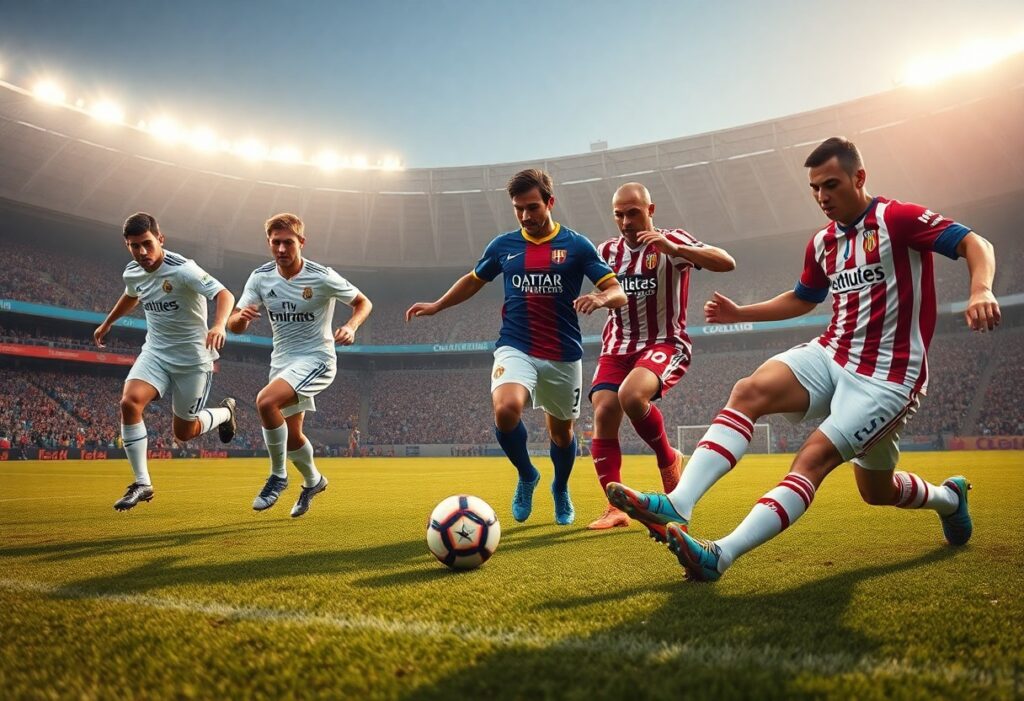
This guide surveys La Liga’s defining figures and analyzes how their tactical innovation, technical brilliance and lethal finishing reshaped clubs, competitions and coaching thought; from record-setting goal-scoring to defensive leadership and global influence, their contributions forged modern football’s style, economics and cultural reach, offering clear lessons for players, managers and fans.
Types of Greatest La Liga Players
Strikers, playmakers, anchors and shot-stoppers all shaped La Liga: Forwards rewrote scoring charts (Lionel Messi: 474 La Liga goals; Cristiano Ronaldo: 311), Midfielders dictated tempo through possession and pressing, Defenders combined leadership with tactical versatility, Playmakers produced key assists and game control, and Goalkeepers delivered match-winning saves and clean sheets.
- Forwards
- Midfielders
- Defenders
- Playmakers
- Goalkeepers
| Forwards | Record scorers (Messi 474, Ronaldo 311) who shifted formations toward attack-heavy systems and press-resistant finishing. |
| Midfielders | Control specialists (Xavi, Iniesta, Modrić) who enabled possession dominance, short passing chains and tempo shifts across title-winning seasons. |
| Defenders | Leadership at the back (Puyol, Ramos) combining aerial strength, tactical fouling and transitional play to launch counterattacks. |
| Playmakers | Creative engines delivering high-value chances and assists-players who changed single matches with vision and risk-taking passes. |
| Goalkeepers | Shot-stoppers and sweepers (Zamora-era standards to modern keepers) who improved defensive metrics and points saved per season. |
Legendary Forwards
Messi and Ronaldo transformed scoring expectations: Messi’s 474 La Liga goals and lateral creativity forced opponents to adapt marking and formations, while Ronaldo’s physicality and efficiency produced seasons with 30+ league goals, shifting recruitment toward athletic, press-resistant forwards.
Iconic Midfielders
Midfield dynamos like Xavi and Iniesta controlled possession phases, made decisive progressive passes and sustained Barcelona’s dominance during the late 2000s and early 2010s, while Luka Modrić brought balance to Real Madrid’s transitions with tempo control and creative counters.
Teams relying on these midfield architects recorded higher possession percentages and more chances created per match; tactical case studies show Barcelona’s 2008-2012 unit frequently exceeded 60% possession and averaged double-digit key passes per game, proving midfield structure drives both trophies and style.
Resilient Defenders
Figures such as Puyol and Ramos combined organization, dominance in aerial duels and the ability to convert set-pieces into goals, prompting managers to value defenders who can both stop threats and start attacks from deep positions.
Assume that modern La Liga defenses succeed when pairing a physical, aerially dominant centre-back with a ball-playing partner who can progress possession under pressure, producing lower expected goals conceded and more clean sheets across long campaigns.
Tips for Recognizing Greatness in Players
Track season-to-season output: La Liga icons like Messi (50 league goals in 2011-12; 474 career La Liga goals) and Cristiano Ronaldo (311 La Liga goals) show how volume and efficiency combine. Evaluate decisive contributions in big matches-goals, assists or defensive interventions that change title races. Examine role evolution: some players grow into leadership and tactical anchors while others remain pure scorers. Use numbers plus match footage to avoid hype. Thou weigh team system and position when assigning a player’s greatness.
- Compare per-90 metrics (goals, assists, xG) for consistent players.
- Weigh performance in key fixtures-El Clásico, title run-ins-for La Liga impact.
- Measure longevity: seasons of top-tier output signal sustained greatness.
Analyzing Individual Skills
Separate technical, physical and cognitive traits: finishing, first touch, acceleration, spatial awareness and decision-making. Use concrete examples-Messi’s 50-goal 2011-12 La Liga campaign illustrates elite finishing and movement off the ball-then cross-check with metrics like shot conversion and successful dribbles per 90. Prioritize repeatable actions over flashy moments; consistent high-percentage actions define lasting skill, especially when a player performs across different coaches and systems.
Evaluating Contribution to Team Success
Measure trophies, goal participation and match influence: a top striker who accounts for >30-40% of a team’s goals shows outsized value, while midfield anchors who increase team possession and progression enable titles. Cite examples: Barcelona’s 2008-09 treble depended on combined contributions from Messi, Xavi and Iniesta. Balance stats with context-tactical role, teammate quality and injury absence-to judge true La Liga impact.
Delve deeper by calculating goal participation (goals+assists divided by team goals); for instance, if a squad scores 80 league goals and a player contributes 32, that’s 40% participation-a clear sign of dependency. Add defensive and transitional metrics: interceptions, recoveries leading to shot-creating actions, and expected assists (xA) show off-ball value. Factor leadership: captains who raise win percentage in one-goal games or provide decisive moments in title-deciding rounds add qualitative weight. Finally, simulate role shifts-does the individual maintain output when the team changes formation? Consistent positive influence across scenarios separates top contributors from supporting stars.
Step-by-Step Guide to Assessing Their Impact
Assessment Framework
| Step | What to measure / Examples |
|---|---|
| Quantitative metrics | Goals per 90, assists, trophies (e.g., Messi’s 50 La Liga goals, 2011-12), Ballon d’Ors, win % |
| Qualitative influence | Positional innovation, leadership, tactical shifts (e.g., Cruyff’s positional play at Barça) |
| Match-level analysis | El Clásico performances, title-deciders, cup finals; clutch goals and hat-tricks |
| Developmental impact | Academy output (La Masia producing Xavi/Iniesta/Messi), coaching pipelines |
| Long-term legacy | Style adoption globally (tiki‑taka spread), changes in scouting and training |
Historical Context
Trace careers against La Liga eras: Alfredo Di Stéfano’s transfer in 1953 catalyzed Real Madrid’s dominance and five straight European Cups (1956-60), Johan Cruyff’s arrival in the 1970s reoriented Barça’s philosophy, and Lionel Messi’s debut in 2004 culminated in a record-breaking 50-goal 2011-12 league season that redefined attacking benchmarks.
Key Matches and Performances
Prioritize El Clásico showings, title-deciding fixtures and seasons with extreme outputs: players who deliver multiple hat-tricks, decisive finals goals, or seasons with 40+ league goals (e.g., Cristiano Ronaldo’s 40-goal campaign) typically shift tactical responses across La Liga.
Case studies illuminate impact: Di Stéfano’s 1950s dominance forced opponents to adapt zonal defenses; Messi’s 2011-12 run (50 league goals) included repeated match-winning performances that altered marking schemes; Ronaldo’s 2010-11 40-goal season prompted Real-to-Barça tactical arms races, with managers adjusting formations to contain individual threats.
Lasting Influence on Future Generations
Assess how careers reshape pathways: La Masia graduates (Xavi, Iniesta, Messi) fueled Spain’s international success (Euro 2008, World Cup 2010, Euro 2012), while managerial successors spread those principles-Pep Guardiola’s Barça era created a coaching tree and scouting emphasis on technique and spatial intelligence.
In depth, quantify influence by academy outputs and coaching proliferation: Barcelona under Guardiola won 14 trophies in four years, producing coaches who export pressing and positional play worldwide; academies increased technical training hours and recruitment criteria, leading clubs across Europe to prioritize ball retention and spatial coaching in youth curriculums.
Factors Contributing to Their Greatness
Elite La Liga figures combined elite technical ability, acute tactical awareness and consistent leadership, producing outsized influence on results and club identity; examples include Messi’s record-setting 50-goal 2011-12 league season and Barcelona’s midfield trio that powered the 2008-09 treble. Recognizing how those pillars interacted-skill enabling tactics, tactics amplifying leadership-explains why a few players defined entire eras.
- Technical Skills
- Tactical Awareness
- Leadership Qualities
Technical Skills
Exceptional first touch, rapid dribbling and clinical finishing separated greats: Messi’s close control and finishing in the box produced his 50-goal 2011-12 haul, while Xavi’s passing range and Iniesta’s balance delivered precision attacks. Coaches relied on those skills to execute high-tempo possession systems, with set-piece technique and long-range accuracy often deciding tight La Liga fixtures.
Tactical Awareness
Players with superior spatial sense read opponents and exploited weak channels; Busquets’ ability to patrol the pivot created passing lanes, and Xavi consistently timed vertical passes to break lines during Barcelona’s dominant periods. Managers like Guardiola designed systems that magnified individual positional intelligence, turning subtle movements into sustained team advantages.
On a deeper level, tactical awareness meant mastering triggers for pressing, rotation patterns and tempo shifts: seasoned players anticipated defensive transitions, nullified counterattacks by occupying passing lanes, and altered formations mid-match to exploit mismatches-skills that turned tactical plans into measurable gains across long La Liga campaigns.
Leadership Qualities
Captaincy often combined vocal direction with leading by example; Puyol’s relentless defending and Ramos’ habit of scoring late, decisive goals provided momentum swings that lifted teammates. Clubs benefited from leaders who organized defense, demanded intensity and handled set-piece responsibilities, giving squads psychological edges in tight title races.
Leadership further manifested in mentoring young talents and sustaining standards over seasons: senior figures enforced training habits, stabilized dressing-room conflicts and influenced transfer integration, producing prolonged periods of success rather than short-term peaks-a defining feature of La Liga’s most enduring champions.
Pros and Cons of Different Player Styles
| Pros | Cons |
|---|---|
| Creates direct goal threat and increases team xG. | Can neglect defensive duties, leaving fullbacks exposed. |
| Provides defensive stability and organization in front of goal. | May limit ball progression and reduce counter-attacking speed. |
| Vision-based playmakers unlock defenses with through balls. | Often physically quieter and vulnerable to high-press traps. |
| Wingers stretch the pitch and create 1v1 advantages. | High turnover risk when cutting inside without cover. |
| Overlapping fullbacks add width and overloads on flanks. | Leave large gaps behind for direct counters. |
| Target men secure long balls and link play under pressure. | Limited mobility makes teams predictable on transitions. |
| False nine creates roaming space for midfield runners. | Can reduce penalty-area presence and finishing options. |
| Box-to-box players supply both phases with stamina and goals. | Positional lapses appear late in games through fatigue. |
| Set-piece specialists add measurable goal probability. | Dependence on dead-ball moments can stall open-play creativity. |
| Versatile players allow tactical switching mid-game. | Role ambiguity may dilute peak performance in key positions. |
Strengths of Offensive Players
Attackers drive results: Messi’s 474 La Liga goals and Ronaldo’s 311 illustrate elite finishing that turns narrow margins into wins. Teams like Real Madrid in 2011-12 (121 league goals) show how prolific forwards lift entire tactical setups, creating space for midfield runners and forcing opponents into conservative shapes. Their pressing from the front also generates turnovers high up the pitch, producing immediate scoring chances and controlling tempo.
Weaknesses of Defensive Players
Strong defenders bring structure but often struggle against pace and positional overloads; high defensive lines are particularly exposed in transition, as seen when teams concede on counters or isolated wide runs. Distribution under pressure can break build-up play, and slower recovery speed turns single turnovers into clear-cut chances for elite attackers.
More detail: center-backs who sit deep excel in aerial duels and set-piece defense yet can be bypassed by quick vertical switches and diagonal balls into channels. Case studies like Barcelona’s collapse at Anfield (2019) highlight how a backline’s misreads and lack of recovery speed compounded into multiple goals; teams then exploit those weaknesses with targeted runs and quick fullback advances to unbalance markers.
Summing up
Hence the greatest La Liga players reshaped football through technical excellence, tactical innovation and cultural influence; their careers elevated club standards, inspired coaching methods, and accelerated global fandom while mentoring generations who adopted and refined their styles, ensuring La Liga’s enduring reputation as a laboratory for elite talent and progressive play.
FAQ
Q: Who are widely regarded as the greatest La Liga players of all time and what achievements set them apart?
A: Lionel Messi, Alfredo Di Stéfano, Cristiano Ronaldo, Johan Cruyff, Ferenc Puskás, Xavi Hernández and Andrés Iniesta are consistently cited among the all-time greats. Messi’s record-breaking goal tallies, assist numbers and Ballon d’Or haul combined with decade-plus dominance at Barcelona define a rare individual-and-team legacy. Di Stéfano transformed Real Madrid in the 1950s, winning multiple European Cups and redefining the attacking all-rounder role. Ronaldo raised athletic standards and scoring efficiency at Real Madrid, breaking club and league scoring records while driving consistent trophy-winning seasons. Cruyff brought Total Football thinking to La Liga as a player and later as a manager, influencing Barcelona’s identity. Puskás’s finishing and pace made him a defining post-war forward. Xavi and Iniesta anchored Barcelona’s midfield for years, delivering sustained control-based football, multiple La Liga and Champions League titles, and shaping the modern playmaking blueprint.
Q: How did these players change tactics and styles of play in La Liga and beyond?
A: They shifted tactical norms in distinct ways: Cruyff’s positional fluidity and emphasis on space and ball circulation seeded the tactical DNA that later became tiki-taka. Xavi and Iniesta refined possession dominance, short-passing patterns and high pressing from midfield, prompting coaches worldwide to value technical midfield orchestration. Messi popularized the modern false-nine/roaming attacker model, blending dribbling, vision and scoring to make single-player creativity central to team strategy. Di Stéfano illustrated the power of interchangeability-attacking, dropping deep and defending-which influenced the utility forward concept. Ronaldo’s athleticism and relentless off-the-ball movement forced defenses to adapt to high-speed, aerial and long-range threats. Collectively they encouraged coaches to prioritize technical training, spatial awareness and integrated pressing systems at youth and professional levels.
Q: What lasting effects have these legends had on La Liga’s global profile, club development, and youth coaching?
A: Their presence elevated La Liga’s international appeal, driving broadcast deals, sponsorship growth and global fanbases for clubs like Barcelona and Real Madrid. Successes tied to these players increased transfer valuations and commercial revenue, enabling clubs to invest in infrastructure and academies. La Masia and other youth systems shifted toward producing technically adept, tactically aware players modeled on these icons, influencing curricula worldwide. Tactically, clubs and national teams adopted possession-based and pressing systems popularized by La Liga stars. Culturally, these players reinforced club identities-Barcelona’s emphasis on technical football and Real Madrid’s focus on elite goalscoring and marquee signings-shaping recruitment philosophies and long-term sporting projects across Europe and beyond.