World Cup 2026 Format: Expanded 48-Team Schedule & Groups


What the 48-team expansion means for you as a fan and a national team
You’re about to experience the biggest change to men’s World Cup football in decades. The 2026 tournament expands from 32 to 48 teams, which reshapes group composition, match totals, travel demands and the overall rhythm of the competition. Rather than being a distant policy shift, this expansion changes how you follow the event, how teams approach early games, and how host cities schedule match days across three host countries.
From a fan perspective, expansion brings more national teams into the world’s biggest stage, increased opportunities to see emerging football nations, and additional broadcast content. From a team perspective, the stakes of each group match intensify: a short group phase with fewer matches amplifies the impact of a single result and alters tactical calculations around rotation, substitutions and risk-taking.
How the group stage is arranged and what the schedule looks like
Group composition and progression
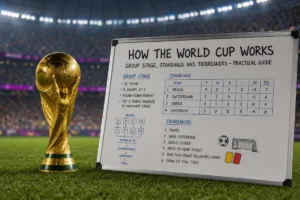
The tournament is organized into 16 groups of three teams each. In each group, every team plays the other two once, producing three matches per group. You’ll see the top two teams from each group advance to a new Round of 32, creating a wider knockout bracket than before.
- Groups: 16 groups × 3 teams
- Group matches: 3 matches per group (each team plays twice)
- Advancement: Top two teams from each group progress to the Round of 32
Match totals, knockout rounds and tournament length
The expanded format raises the total number of tournament fixtures you can watch. The math breaks down like this:
- Group-stage matches: 16 groups × 3 matches = 48 matches
- Knockout-phase matches (including third-place match): 32 matches
- Total matches across the tournament: 48 + 32 = 80 matches
Compared with the 64-match schedule of a 32-team World Cup, you’ll have 16 extra fixtures to follow. The tournament still follows a single-elimination knockout after the group phase, but now begins at a larger Round of 32 rather than the Round of 16 you’re used to.
Scheduling implications you should know
Because each team plays only two group matches, match ordering and rest days become more consequential. Organizers will stagger fixtures across multiple venues in the United States, Canada and Mexico, so travel logistics and recovery windows will vary by host city. You’ll likely see more simultaneous or closely timed matches to maintain competitive fairness, and the condensed group schedule increases the importance of timely results.
With that context in place, the next section will break down how tiebreakers, matchday order, and venue assignments are designed to reduce collusion risk and ensure fairness across the 16 groups.
Tiebreakers: how ties will be broken and why every goal (and card) matters
With only two matches per team in the group stage, small margins are amplified — and FIFA’s tiebreaker rules become a decisive part of the tactical calculus. While the exact wording the organizers use in the official 2026 regulations will be authoritative, expect the usual hierarchy of criteria you’ve seen in past World Cups and major FIFA competitions: overall points, goal difference, goals scored, results between tied teams (head-to-head), disciplinary/fair-play points, and ultimately drawing of lots if everything else is identical.
A few practical implications follow:
– Goal difference and goals scored gain extra weight. With only two games, a single heavy defeat or a missed chance can sink a team’s progress chances — so teams have a stronger incentive to attack when leading and avoid passive, defensive tactics that preserve only a narrow margin.
– Head-to-head can be messy in three-team groups. Because every team plays the other two once, you can easily get a three-way tie on points. In that case overall goal difference and goals scored are often the first deciders, which pushes squads to think about cumulative scoring across both fixtures rather than one-off tactical wins.
– Fair-play points are meaningful deterrents to cynical fouling. Yellow and red cards can tip tightly contested tiebreakers, so discipline matters more than ever — coaches will underline the importance of staying composed because cards may be the difference between advancing and elimination.
– The small-group format increases the possibility of drawing-of-lots scenarios, so organizers will include transparent protocols and publicized contingency plans to maintain trust and legitimacy should rare, extreme ties occur.
In short: every shot, every clearance and every booking is materially important. Fans should watch both group matches as if they were knockouts — the math behind tiebreakers means that even late consolation goals or an ill-timed red card can rewrite the standings.
Matchday order, venue assignments and travel fairness across three host countries
How matches are ordered within each group and which cities host them will shape competitive fairness as much as the rules themselves. With the tournament spread across the U.S., Canada and Mexico, organizers face two aims: minimize unfair travel burdens and curb opportunities for collusion by smartly timing fixtures.
A few operational points to expect:
– Rotating match order across groups. Not every group will follow the same schedule (e.g., A vs B first, C vs A second, B vs C third). FIFA and Local Organizing Committees will vary orders and spread decisive fixtures across days and venues to avoid predictable advantages for teams who simply benefit from knowing earlier results.
– Regional clustering where possible. Early pool play will be allocated to geographically proximate cities to reduce overnight travel and excessive time-zone swings — beneficial for player recovery and for fans planning to follow a team in person. Nevertheless, cross-border travel will be unavoidable in knockout rounds and some group assignments.
– Rest-day parity and recovery windows. Scheduling will aim to standardize minimum rest days between games for teams in the same round, but long-haul transfers (e.g., Mexico to eastern U.S.) could impose tougher recovery demands. Expect teams with deeper squads to use rotation strategically when travel-heavy fixtures arise.
– Broadcast and kick-off balancing. High-profile fixtures will be slotted to reach key TV markets, which can mean late local kickoffs or early starts for some venues. Fans should check official schedules early and account for potential time-zone inconveniences.
Ultimately, fairness isn’t just about rules on paper — it’s about how matchdays, travel and timetables are managed. The organizing bodies will publish detailed venue and matchday plans well in advance so fans and teams can plan around the realities of a transnational World Cup.
Fan planning: tickets, travel and following the tournament
Tickets and travel logistics
If you plan to attend matches in person, start by checking official ticketing channels early and confirm travel requirements between host cities. With three host countries and matches clustered regionally, many fans will choose a base city for group-stage games and then travel for knockout rounds. Book accommodations and domestic transport well in advance to avoid last‑minute price spikes and limited availability.
Broadcasts, streaming and official updates
Broadcasters and streaming partners will hold rights across different markets, so confirm which platform will carry games in your country and whether blackout rules apply. For the most authoritative schedules, ticketing details and match updates, consult the FIFA tournament hub: FIFA 2026 official site.
Looking ahead
The 2026 World Cup will reshape how the tournament is experienced — more teams, more matches and a wider global footprint. Whether you’re traveling between host cities or watching from home, plan ahead, follow official channels for schedule changes, and get ready for an extended celebration of international football.