Football Betting Odds Comparison: Where to Get the Best Value

Why comparing football betting odds will protect your bankroll
You might think that a small difference in price doesn’t matter, but when you bet regularly those margins add up. Comparing football betting odds is one of the simplest, highest-impact actions you can take to increase long-term returns. By routinely shopping around, you reduce variance against the market, capture better expected value, and make each bet work harder for you.
This section explains the basic reasons to compare odds and what to look for so you can start getting better value immediately. You’ll learn how odds express probability, why bookmakers differ on the same event, and where to find quick comparisons without spending hours manually checking sites.
How odds translate into implied probability and value
Odds are just another way to express probability. If you understand the implied probability behind an odd, you can judge whether the market is under- or over-pricing an outcome compared to your own estimate. For example, decimal odds of 2.50 imply a 40% chance (1 ÷ 2.50). If your analysis suggests the real chance is 48%, that price represents positive expected value (EV).
- Decimal odds — popular in Europe and straightforward for EV math.
- Fractional odds — traditional in the UK; convert to decimal for comparison.
- American odds — common in the US; convert to implied probability for cross-checks.
When you compare odds across bookmakers, you’re looking for discrepancies where one book offers a higher price than the rest. Those discrepancies may be brief or persistent, driven by liquidity, model differences, or the book’s risk exposure. Your goal is to capture those edges consistently.
Where to check odds and practical tools for quick comparisons
Not all sources are equal. Some bookmakers specialize in particular leagues and regularly offer sharper prices there; others hedge risk by offering broader markets but slightly worse prices. You should build a short list of resources that let you compare prices fast and reliably.
Fast checklist: platforms and tools to use
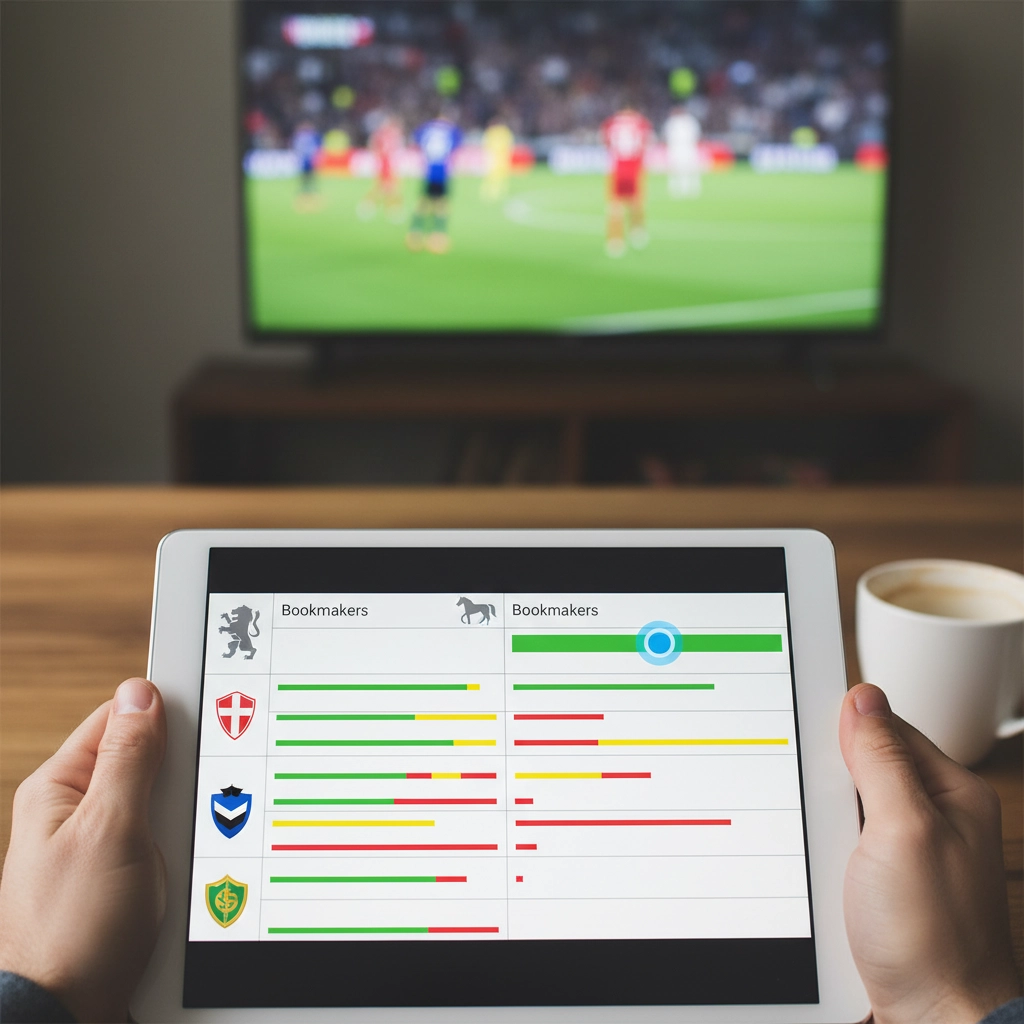
- Odds comparison websites — aggregate prices across many bookmakers and let you sort by best price quickly.
- Bookmaker accounts — having accounts with 3–6 reputable books lets you act when you spot value.
- Betting exchanges — often provide the best mid-market prices and let you both back and lay.
- Mobile apps with alerts — set push alerts for price moves on selected markets.
Set up a workflow: check an odds comparison site first, verify the best price in your bookmaker accounts, and use a calculator or spreadsheet to compute implied probability and EV before staking. Doing this routinely will shift your returns in a meaningful way.
In the next section you will learn how to convert between odds formats, use an odds calculator to quantify value, and run a simple comparison routine you can follow before placing any football bet.
How to convert odds and quantify value quickly
Understanding how to move between formats and turn prices into expected value (EV) is a practical skill you should have at your fingertips. Here are the conversions and a simple way to calculate whether a price is worth taking.
– Convert to implied probability:
– Decimal: implied probability = 1 ÷ decimal odd. Example: 2.50 → 1 ÷ 2.50 = 0.40 (40%).
– Fractional (e.g. 6/4): convert to decimal first → (6 ÷ 4) + 1 = 2.50 then use the decimal method.
– American: if positive (e.g. +150) → decimal = (american ÷ 100) + 1 = 2.50. If negative (e.g. -200) → decimal = (100 ÷ |american|) + 1 = 1.50.
– Check bookmaker margin (vig):
– Add implied probabilities for all mutually exclusive outcomes and subtract 100%. The remainder is the overround. Example in a 1X2 market: if implied probabilities sum to 104%, the market margin is 4%.
– Calculate expected value quickly:
– If your estimated true probability is p and the decimal price is d, expected profit per $1 = p × d − 1. Positive = value. Example: you estimate a 48% chance (0.48) and one bookmaker offers 2.80: EV = 0.48 × 2.80 − 1 = 0.344 → 34.4¢ expected profit per $1 staked. Same event at 2.50 gives EV = 0.48 × 2.50 − 1 = 0.20 → 20¢ per $1. That difference compounds when you bet repeatedly.
Odds calculators (web or mobile) automate these conversions and let you enter your probability to see EV instantly. Keep a small spreadsheet or use a simple app to paste decimal odds and calculate implied probability, your edge, and stake suggestions. When you spot a positive EV, check that the stake fits your bankroll rules before pulling the trigger.
A simple pre-bet odds comparison routine you can follow
Turn comparisons into a short habit with this 6-step routine. It takes a couple of minutes and prevents emotional, rushed bets.
1. Quick scan: open your preferred odds comparison site and filter to the market (match winner, total goals, BTTS, etc.). Note the best three prices.
2. Verify in accounts: log into your bookmaker and exchange accounts to confirm the displayed best price is available and check maximum stake/limits.
3. Convert and assess EV: use your calculator/spreadsheet to convert the best price to implied probability and compute EV against your model’s probability.
4. Check market practicalities: look at liquidity (especially on exchanges), last-match news (injuries, line-ups), and whether the best price is a temporary error or backed by volume.
5. Factor costs: subtract exchange commission or account for bonus rollover restrictions and bet size caps. A seemingly small edge can vanish once commission or limits are applied.
6. Place or walk away: if EV is positive and the stake is within your staking plan, place the bet. If not, save the observation for future tracking.
If you do this routinely you’ll reduce missed opportunities and prevent betting at inferior prices. Keep accounts funded, set price-move alerts for markets you follow, and log every bet (odds taken, book, stake, outcome). That recording is the only way to measure whether your line shopping is improving ROI over time.
Common pitfalls when shopping for odds — and how to avoid them
– Ignoring exchange commissions and bookmaker limits — always factor these into EV calculations.
– Chasing minute edges without a staking plan — small edges require discipline and sizing rules to be profitable.
– Relying on one comparison site — use 2–3 sources and verify prices in-account.
– Missing contextual information — odds can move for valid reasons (late team news) so don’t chase stale prices.
– Failing to track closing-line value — record your odds versus closing prices; consistently beating the closing line is a strong indicator of real edge.
Avoid these mistakes and the practice of line-shopping will become a measurable advantage rather than a time-sink.
Putting it into practice
Start small, be methodical, and treat odds comparison as a routine skill rather than a one-off tactic. The simplest way to begin is to automate the repetitive parts (alerts, odds-capture, basic EV calculations) and focus your manual attention on markets where you have an edge. Keep accounts funded and verified so you can act quickly when a genuine opportunity appears.
- Open accounts at 2–3 reputable bookmakers and one exchange; use an odds aggregator like OddsPortal to monitor best prices.
- Create a lightweight spreadsheet or use an app to convert odds, compute implied probabilities, and log every bet versus the closing line.
- Set strict staking rules and a small test bankroll to validate your process — measure ROI and closing-line performance after 100–200 bets before scaling.
- Use alerts for markets you follow, verify prices in-account, and always factor in commissions and limits before placing a wager.
Frequently Asked Questions
How can I tell if an odd represents value?
Convert the odd to implied probability and compare it to your own estimated probability for the outcome. Calculate expected value (EV) as EV = p × decimal − 1. If EV is positive after accounting for commissions and limits, the price represents value.
Is it always best to take the highest listed price?
Not always. The highest price is preferable only if the stake is available, there’s sufficient liquidity (on exchanges), and the price isn’t a temporary error. Also factor in commission, max stake limits, and whether late team news might justify the movement.
How do I track whether my odds shopping is actually improving results?
Record every bet with book, market, odds taken, stake, and outcome. Compare your odds to the market closing price to measure closing-line value and track ROI over time. Consistently beating the closing line and improving ROI are the clearest signs your line shopping works.