VAR Decisions Explained: How Video Assistant Referee Works

Why VAR exists and how it changes the game you watch
You’ve likely seen a match pause while referees consult a monitor or watched a screen show a slow-motion replay with lines and circles. VAR, the Video Assistant Referee system, was introduced to reduce clear and obvious errors in match-defining situations. Its purpose is not to remove human judgment from football but to give referees reliable information when an important decision could alter the result.
When you understand VAR’s role, you’ll see it as a corrective tool rather than a replacement for the referee’s instincts. VAR targets a small set of incidents — typically goals, penalty decisions, direct red-card incidents, and cases of mistaken identity — that have the greatest impact on fairness. You’ll also notice that different competitions apply VAR protocols with slight variations, but the core goal remains consistency and accuracy.
How VAR affects the pace and drama of a match
You might feel frustration when a stoppage interrupts momentum, but that pause aims to prevent a more significant injustice later. VAR can confirm a legitimate goal, overturn a wrong call, or catch an offside by fractions of a second. Understanding the trade-off between flow and correctness helps you appreciate why officials accept brief interruptions to secure the right outcome.
When VAR intervenes: clear categories and the on-field review process
VAR doesn’t review every tackle, off-the-ball shove, or every marginal offside. You should know the four primary categories typically subject to review:
- Goals and any offences in the build-up (e.g., fouls, handball, offside)
- Penalty decisions (awarded or denied)
- Direct red-card incidents (serious foul play, violent conduct)
- Mistaken identity shown by the referee
When an incident occurs, the VAR team watches live feeds and flags potential clear and obvious errors to the on-field referee. The referee can then accept the VAR advice or perform an on-field review (OFR) at a pitchside monitor. You’ll often see the referee make a T-sign with their hands to indicate a VAR review or point to the monitor to show they’re personally checking the footage.
What “clear and obvious error” means for decisions you care about
Not every tight call qualifies for overturning. The standard “clear and obvious error” is intentionally high: VAR is meant to correct only situations where the original decision is clearly wrong based on the available footage. That standard preserves the referee’s authority and reduces excessive tinkering with marginal judgments. When you watch a reversal, it’s because the VAR team and the on-field referee found decisive visual evidence the initial call was incorrect.
Who reviews the footage, what technology they use, and how long it takes
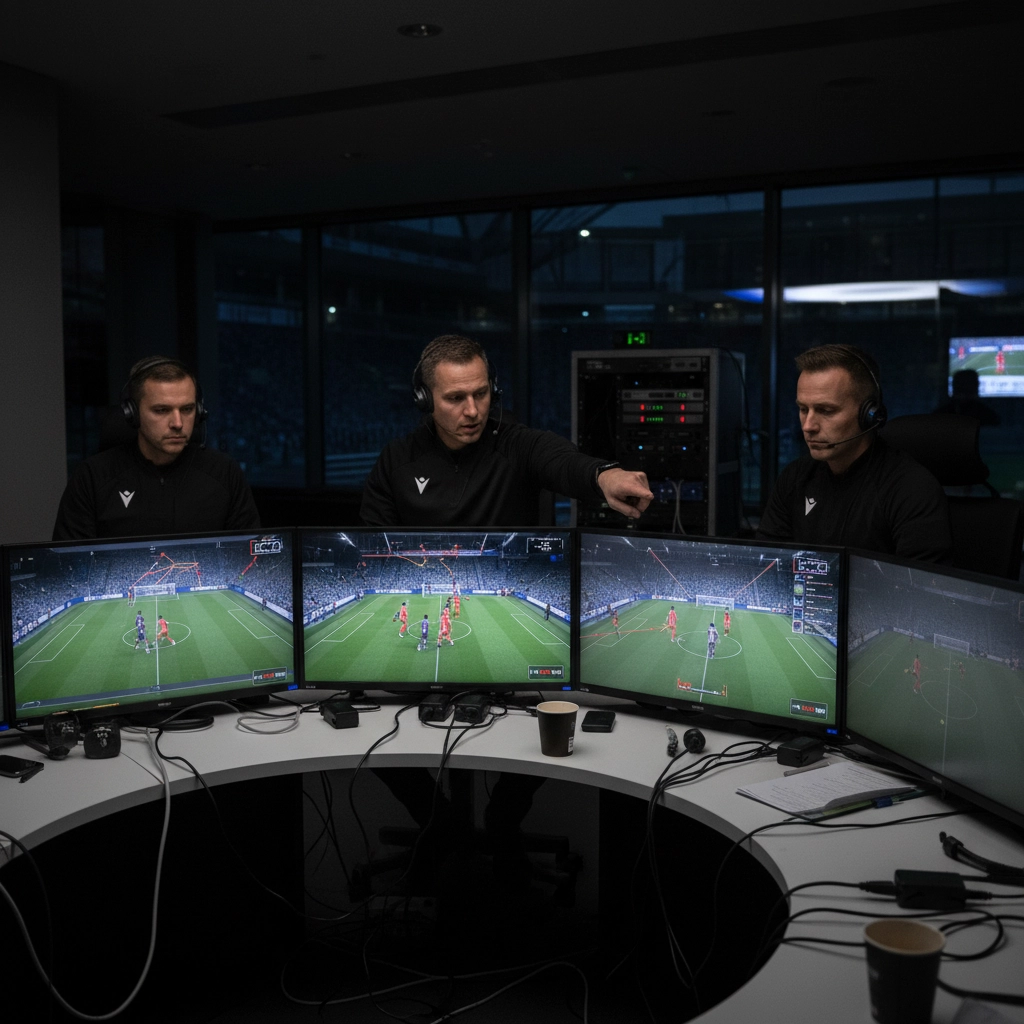
The VAR operation involves a small team: the Video Assistant Referee, an Assistant VAR, and replay operators. They have access to multiple camera angles, slow motion, and calibrated offside technology in many competitions. Reviews are generally quick — often under a minute for routine checks — but complex incidents with many angles or VAR-assisted offsides can take longer.
Next, you’ll learn a step-by-step walkthrough of a typical VAR review during an actual match, including how officials communicate decisions to players and spectators and how offside technology determines marginal calls.
A step-by-step VAR review during a match
When an incident occurs that might fall under VAR’s remit, the process follows a clear sequence designed to be fast and transparent. First, the VAR team watches the live feeds and, if they spot a potential clear and obvious error, they communicate with the on-field referee via a dedicated headset. The VAR will typically say something like “check” and briefly describe the angle or nature of the concern.
From there one of three things usually happens:
- Immediate confirmation: the referee accepts the VAR’s information and changes the decision without stopping play again (for example, awarding a penalty after being told a handball in the build-up is clear).
- On-field review (OFR): the referee travels to the pitch-side monitor to view the footage personally before making the final call. You’ll often see the referee point to their ear or make the on-field review signal.
- No clear error: the VAR recommends no change, and play resumes.
During an OFR the referee watches selected angles and slow-motion replays; they’re looking for decisive visual evidence rather than multiple subjective interpretations. After reviewing, the referee returns to the field and signals the outcome — overturn, confirm, or proceed — using the same standardized gestures (e.g., penalty signal, red card shown). In many stadiums the final decision is also displayed on the big screen with a short explanation so spectators know why the call changed.
How offside technology determines marginal calls
Offside decisions are the most common and also the most technically demanding VAR reviews. Modern systems combine multiple camera angles with calibrated lines drawn across the pitch to indicate the relative positions of attacker and defender at the moment the ball is played. Some competitions now use semi-automated offside technology (SAOT), which tracks player skeletons and the ball in three dimensions to generate an extremely precise frame-by-frame picture.
Key factors in offside rulings include which body part is relevant (any part that can legally play the ball), the exact frame when the ball is played, and the alignment between that body part and the last defender. VAR operators choose the decisive frame — usually the one where the passer’s foot or arm makes contact — and apply the calibrated lines. If the attacker is ahead, the on-field decision is overturned; if the margin is within the system’s error tolerance or inconclusive, the original call stands. Because the technology accounts for camera parallax and player movement, it reduces controversy in very tight situations, though no system is completely infallible.
Communicating decisions to players, coaches, and fans
Transparency is central to acceptance. Referees explain their final decision on the pitch with the standard signals, and stadium screens or announcers often summarize the reason. Some leagues publish raw VAR clips or provide short video explanations after the match to further clarify why a call changed. For teams and coaches the audible headset messages aren’t broadcast, but the sequence of VAR checks and any referee OFR is usually evident to everyone watching — which helps manage frustration by showing that a thorough process was followed.
Looking ahead: VAR’s place in the modern game
VAR is now an established part of elite football, but it remains a living system — continually refined through rule tweaks, operator training and improved technology. Its long-term success depends less on eliminating every controversial moment and more on striking the right balance between accuracy, speed and the human judgment that gives the sport its character. Better communication, clearer broadcast visuals and advances such as semi-automated offside tracking will shape how fans, players and officials accept VAR going forward.
For readers who want to explore the official protocols and ongoing updates, see the governing guidance at The IFAB.
Frequently Asked Questions
What types of incidents can VAR review?
VAR is used for four match-changing categories: goals (including offences in the build-up), penalty incidents, direct red card incidents, and cases of mistaken identity. Less clear-cut or purely subjective decisions generally remain with the on-field referee.
How long does a typical VAR review take?
Reviews vary in length: many are resolved within a few seconds when the VAR communicates a clear-and-obvious error, while on-field reviews (OFRs) that require the referee to view footage at the pitch-side monitor typically take longer—usually under a minute, though complex situations can extend that time.
Can VAR overrule the on-field referee completely?
VAR can recommend changes and, where evidence shows a clear and obvious error, the on-field decision is usually overturned. However, the on-field referee retains final authority and may conduct an on-field review before confirming any change; VAR is intended to support, not replace, the referee’s judgment.