A Concise History of Football: Key Milestones and Dates

From folk play to formal sport: why the early history of football matters to you
You can better appreciate modern football when you trace how informal ball games evolved into a codified sport. The story explains why different countries developed distinct philosophies (handling vs. kicking, amateur vs. professional) and why governing rules were necessary. Knowing the early milestones also reveals how social change — urbanization, schools, and industrial travel — helped football grow from village rituals into a global pastime.
Ancient and medieval ball games that set the stage
Football’s roots are diffuse: societies across the world played ball games that involved kicking, carrying, or striking a ball. These games shared simple features — team competition, goals or targets, and often a ritual context — that later influenced organized football.
- Cuju (China, c. 2nd century BC–3rd century AD): Often cited as one of the earliest documented kicking games; played for recreation and military training.
- Episkyros and harpastum (Greece and Rome): Team ball games with physical play and strategic positioning, described in classical sources.
- Medieval Europe (Middle Ages): “Mob football” in towns and villages involved large numbers of players, few rules, and contests between neighboring parishes or guilds; matches could last hours and travel across the countryside.
- Local codifications like Calcio Fiorentino (Florence, 16th century): City-based variations that combined athleticism and ritual, offering early examples of structured play.
These early iterations were rarely standardized. They were shaped by local custom, seasonality (often around festivals), and social class, so the same “game” could look very different from place to place. For you, this means the idea of a single, linear origin for football is misleading — the sport emerged from many parallel traditions.
Why 19th-century Britain became the pivot point for modern football
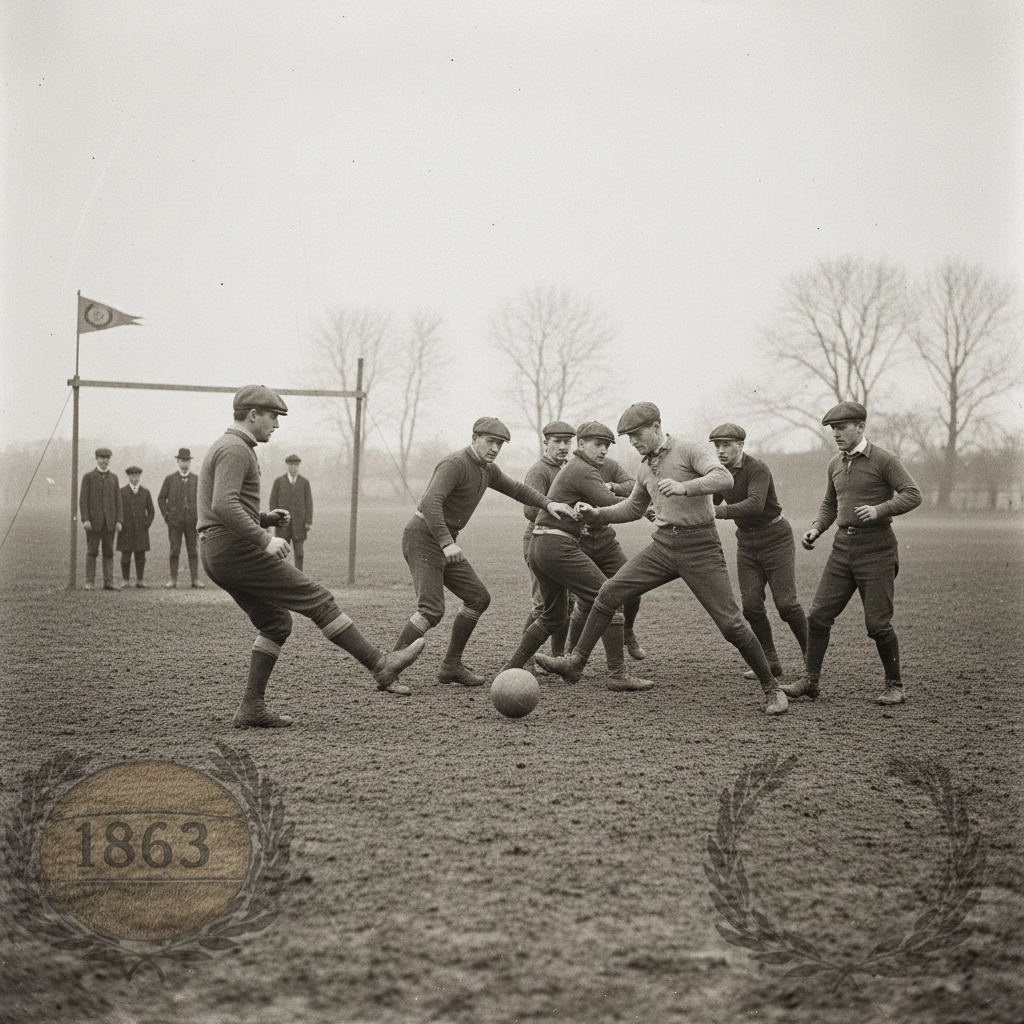
By the 1800s, Britain’s social transformations created the conditions for codification. Public schools, universities, and urban clubs sought consistent rules so teams could play each other. You’ll notice two important trends: the move from local, chaotic games to organized club play, and debates over allowed physical contact.
- Cambridge Rules (1848): An early attempt to reconcile differing school rules into a shared code for kicking games.
- Formation of The Football Association (1863): Representatives from London clubs and schools met to standardize rules for association football; the FA’s laws prohibited most handling and helped separate “football” (soccer) from rugby-style games.
- First organized competitions (1871 onward): The FA Cup began in 1871, introducing regular inter-club contests and public interest in organized tournaments.
These milestones established the legal and cultural framework you now recognize as modern football: set ball, defined pitch, clear rules, and organized competitions. Next, you’ll follow how those rules spread internationally and how governing bodies and competitions shaped the 20th-century game.
International governance and the birth of global competitions
By the turn of the 20th century, the need for cross-border coordination became obvious: different nations played by different rules, and international matches multiplied. That practical problem led to institutional responses that still define the sport for you today. FIFA was founded in 1904 to supervise international fixtures and standardize laws; its authority grew slowly but steadily. The Olympic football tournaments in the early 20th century offered an early international stage, but it was the inaugural FIFA World Cup in 1930 — organized by Uruguay — that transformed football into a truly global competition, giving national teams a recurring, high‑profile prize around which styles and ambitions could coalesce.
Post‑World War II developments accelerated international club and continental contests. The European Cup (now the UEFA Champions League) started in 1955, creating a yearly inter‑club rivalry that raised tactical sophistication, club finances, and cross‑border player movement. Regional confederations (UEFA, CONMEBOL, CAF, AFC, CONCACAF, OFC) formalized continental championships, and FIFA’s expansion of competitions widened football’s reach into Asia, Africa, and the Americas. Televised matches and improved travel knit spectators around the world into a single, shared calendar — a change that turned local allegiances into global fan bases and made international trophies the benchmarks of success.
Professionalism, tactics and rule changes that shaped modern play
As clubs professionalized, the game itself evolved through tactical innovation and targeted rule changes intended to improve fairness and spectator appeal. You’ll recognize a few pivotal shifts: the 1925 offside law amendment (reducing the number of defending players required to keep an attacker onside) stimulated more attacking football and led to the classic W‑M formation. Mid‑20th‑century systems like Italy’s catenaccio emphasized defense and organization; by contrast, the Netherlands’ Total Football in the 1970s prized positional fluidity and technical skill, influencing coaching worldwide.
Rule additions also altered match flow and strategy. Substitutions (gradually introduced mid‑century), yellow/red cards (1970), and restrictions such as the 1992 back‑pass rule changed goalkeeper involvement; the offside interpretation and enforcement continued to be refined. More recently, the introduction of goal‑line technology and VAR has aimed to reduce clear errors, reshaping match outcomes and tactics around stoppages and reviews. Commercialization — broadcast contracts, sponsorship, and player transfer markets — amplified these changes, making tactical success as much a financial imperative as a sporting one.
Women’s football: setbacks, revival, and rapid growth
Women’s participation has been part of football’s story since the early 20th century, but its trajectory was uneven. Wartime factory teams and high‑profile exhibition matches in the 1920s drew large crowds, only for the English FA to impose a ban on women’s matches at FA‑affiliated grounds in 1921, which stifled development for decades. The ban’s eventual lifting and the wider push for gender equality from the 1970s onward catalyzed organized leagues and international competition.
The FIFA Women’s World Cup, inaugurated in 1991, provided a global showcase that boosted investment and visibility. Since then, growth in participation, professional leagues, broadcasting, and commercial support has been rapid; major national teams now attract massive audiences and professional infrastructure. For you, this means modern football is not just a story of men’s clubs and competitions but an expanding, more inclusive sport whose recent milestones are reshaping its future.
A living game: continuity and change
Football’s past is full of decisive moments, but its future will be shaped by ongoing choices — about governance, technology, equality, and the sport’s place in society. Expect continued tension between global commercialization and local identity, further integration of technology into officiating and training, and growing investment in the women’s game and grassroots pathways. Clubs, confederations, players, and fans will keep negotiating what football means and how it should be run; how those conversations resolve will determine the next set of milestones.
For those interested in the institutional side of that evolution, official bodies remain central to rule changes and international competitions — see the FIFA website for current competitions and governance updates. Whatever specific developments lie ahead, the sport’s mixture of cultural resonance, tactical innovation, and broad participation suggests football will keep adapting while remaining widely beloved.
Frequently Asked Questions
When and why was FIFA founded?
FIFA was founded in 1904 to coordinate international fixtures, standardize rules across nations, and oversee cross‑border competition as international matches became more frequent.
Which rule change most influenced attacking tactics?
The 1925 amendment to the offside law — reducing the number of defending players required to keep an attacker onside — had a major impact, encouraging more attacking play and prompting tactical formations like the W‑M.
When did the FIFA Women’s World Cup begin?
The first FIFA Women’s World Cup was held in 1991, providing a dedicated global tournament that significantly raised the profile and investment in women’s football.