Premier League History Timeline: From 1992 to Today

How the Premier League’s 1992 launch reshaped English football and what it meant for you
When the top clubs broke away from the old First Division in 1992, they set in motion a transformation you still see in every matchday: bigger TV deals, global audiences, and a faster, more attack-minded style of play. The Premier League wasn’t just a new name — it was a new business model and a cultural reset. As you trace this timeline, you’ll notice how rule changes, strategic broadcasting partnerships, and high-profile managerial appointments combined to turn English domestic football into a global product.
To understand the Premier League’s early years you should look at three linked developments: the structural split from the Football League, the landmark television agreements that increased revenue, and the on-field changes—such as tactical innovations and new player movements—that reshaped how the game was played in England.
1992–1997: The first seasons, landmark moments, and who dominated early on
The inaugural 1992–93 season set the tone. Manchester United, led by Sir Alex Ferguson, claimed the first Premier League title and began a period of sustained success that would define the 1990s. Within a few seasons you saw both predictability and drama: well-resourced clubs consolidated power, while surprising challengers briefly broke through.
- 1992–93: Manchester United wins the first Premier League title after decades without a top-flight crown.
- 1994–95: Blackburn Rovers, powered by heavy investment and the strike partnership of Shearer and Sutton, win the title — a reminder that new money could quickly alter the pecking order.
- 1995–97: Arsenal, Chelsea, and Newcastle show signs of emerging competitiveness, while Manchester United reasserts its dominance.
Alongside the trophies, you should note pivotal off-field events: the back-pass rule (introduced in 1992) and the Bosman ruling (1995) both changed tactics and transfer dynamics. The back-pass rule forced goalkeepers into a more active role and encouraged attacking play, while Bosman increased player mobility across Europe, helping foreign players and managers arrive in larger numbers.
Why television deals and managerial arrivals mattered in the league’s formative years
One of the clearest shifts you can trace is commercial. Sky Sports’ landmark rights deal funded higher wages, transfer spending, and stadium improvements. The new revenues meant clubs could attract international talent and hire innovative managers. You should pay particular attention to the arrival of Arsène Wenger at Arsenal in 1996 — his methods (diet, training, tactics) signaled a modern approach that influenced rivals and improved the league’s technical level.
- Broadcasting: Greater TV money created financial clout and a global audience.
- Managers: Tactical newcomers such as Wenger introduced continental ideas and sports science.
- Players: An influx of foreign stars increased the league’s quality and marketability.
As you prepare to follow the timeline into the late 1990s and early 2000s, you’ll see how these early shifts—commercial firepower, managerial innovation, and regulatory changes—laid the groundwork for a decade of intense competition and growing global reach. Next, you’ll examine the Premier League’s move from consolidation to outright global dominance and the key seasons that defined that transition.
1997–2004: Manchester United’s peak, Arsenal’s revolution, and the rise of the modern title race
The late 1990s and early 2000s are where the Premier League’s narrative splits into two clear strands: Sir Alex Ferguson’s Manchester United consolidating into a dynasty, and Arsène Wenger’s Arsenal remaking what elite English football could look like. United’s 1998–99 season — the historic treble of Premier League, FA Cup and Champions League — was more than a collection of trophies; it proved the commercial model and squad-building strategies that elite clubs would emulate worldwide. United’s success boosted global merchandising, sponsorship and TV audiences, reinforcing the gap between the richest clubs and everyone else.
At the same time, Arsenal under Wenger introduced sustained technical and tactical shifts: emphasis on ball retention, sports science, and a continental scouting network that brought players like Thierry Henry and Patrick Vieira into the English game. Their 2001 double and, crucially, the unbeaten 2003–04 “Invincibles” season made tactical sophistication a prerequisite for challengers — not just raw spending.
Key features of this period you should note:
– The transfer market escalates: fees and wages rose as clubs pursued elite talent (Ronaldo’s 2003 move to United and multiple high-profile signings set new benchmarks).
– Managerial influence deepened: the Premier League became a destination for big-name continental managers whose ideas shaped training, nutrition and youth development.
– Competitive storylines multiplied: while United and Arsenal often led the way, Chelsea, Liverpool and Newcastle periodically mounted serious challenges, keeping title races compelling for viewers worldwide.
2004–2010: New owners, Champions League drama, and the Premier League as a global brand
From 2004 onward the league’s economic and geopolitical dynamics shifted even more rapidly. Roman Abramovich’s 2003 takeover of Chelsea — followed by heavy investment — inaugurated the era of owner-fueled revolutions; clubs could leapfrog decades of gradual growth through concentrated capital. That model would be replicated later by other sovereign-backed and ultra-wealthy owners. The result was sharper short-term success for some clubs, faster inflation in transfer fees, and a strategic arms race for managerial and player talent.
On the pitch, English clubs began making indelible European statements. Manchester United’s continued domestic success and Liverpool’s dramatic 2005 Champions League triumph (the “Istanbul” final) underscored that the Premier League could produce continental glory as well as domestic spectacle. Those nights amplified the league’s global appeal and made Champions League qualification a major commercial as well as sporting goal.
Between 2007 and 2010 you also saw new entrants to the wealthy-owner model (notably Manchester City’s 2008 takeover) begin to reshape the hierarchy. The combined effect of increased broadcast revenues, foreign investment, and high-profile player moves turned the Premier League into a global sporting brand — one defined by intense rivalries, astronomical transfer markets, and expanding international fanbases. These years set up the modern contours of competition you recognize today: concentrated wealth, managerial star power, and a relentless focus on both domestic leagues and European success.
2010–Today: New dynasties, shocks, and institutional change
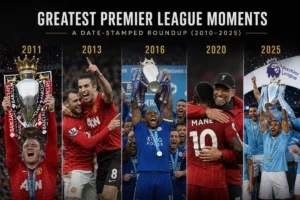
The 2010s and early 2020s solidified trends that began earlier while adding fresh narratives. Manchester City’s sustained investment translated into multiple title-winning cycles, and managerial systems — notably Pep Guardiola’s — pushed tactical expectations higher across the league. Liverpool’s resurgence under Jürgen Klopp delivered high-intensity pressing football and a return to continental success, while Leicester City’s 2015–16 title remained the definitive underdog story that reminded everyone of the league’s unpredictability.
Off the field, massive broadcast deals, the introduction of VAR, evolving Financial Fair Play rules and the pandemic-era disruptions forced clubs and governing bodies to adapt rapidly. Youth development, analytics and sports science became standard across squads, and the global fanbase continued to expand through digital platforms and international partnerships.
The Premier League’s next chapter
Rather than stand still, the Premier League has proven to be a living institution — shaped as much by new money and technology as by moments of drama, tactical evolution and cultural shifts. Its future will be decided by how clubs balance financial sustainability, competitive integrity and global appeal, and how the game absorbs innovations from analytics to broadcast delivery. For anyone tracking where elite football goes next, watching the Premier League offers a front-row seat to both continuity and change. For official fixtures, rules and developments, consult the Premier League official site.
Frequently Asked Questions
Who has won the most Premier League titles?
Manchester United hold the most Premier League titles in the competition’s history, an era-defining tally that underpinned their global influence during the 1990s and 2000s.
Why was Manchester United’s 1998–99 treble so important?
The treble demonstrated how on-field excellence, squad construction and commercial growth could combine to elevate a club’s global status. It also served as a blueprint that other elite clubs sought to emulate in both sporting and business terms.
How did foreign owners change the Premier League?
High-profile takeovers (notably Chelsea and Manchester City) accelerated spending, reshaped competitive hierarchies and prompted new strategies in recruitment, infrastructure and marketing—forcing rivals to adapt through their own investment or innovation.