La Liga Legendary Players: From Di Stéfano to Messi
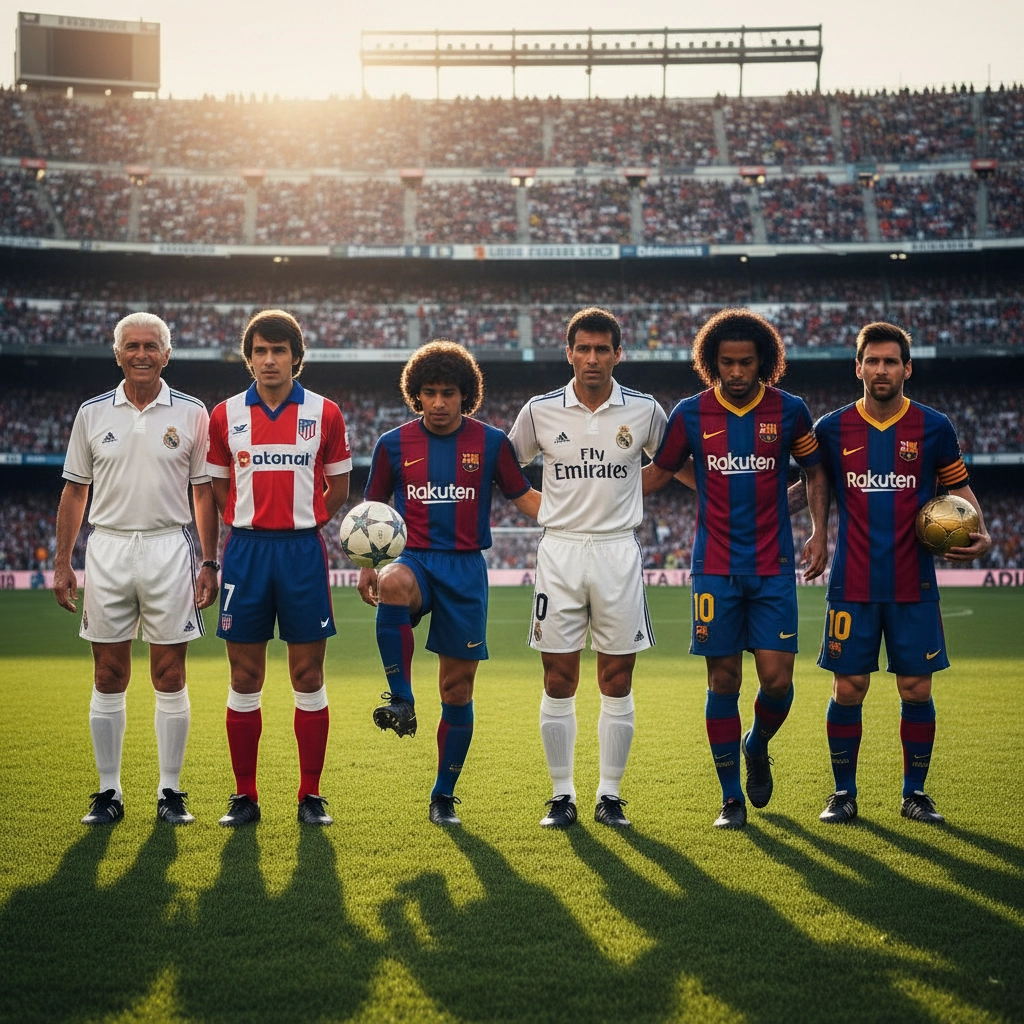
Why La Liga’s early heroes still matter to the modern fan
When you study La Liga, you’re looking at more than lists of top scorers and trophy cabinets. You are tracing how a football culture evolved: the tactics that became orthodox, the rivalries that defined regional identity, and the stylistic threads that link a 1950s forward to a 21st-century magician. This section grounds you in the league’s formative decades so you can appreciate how later icons built on, reacted to, and transformed that legacy.
La Liga in its early years was both experimental and intensely competitive. Teams relied on international imports, local prodigies, and managerial innovation to claim supremacy. As you read, pay attention to how individual brilliance often precipitated tactical shifts — a recurring pattern that connects Di Stéfano to later figures like Johan Cruyff and ultimately to Messi.
The Di Stéfano revolution: how one player reshaped Real Madrid and the league
Alfredo Di Stéfano arrived in Spain in the early 1950s and altered expectations about what a forward could be. If you imagine the archetypal striker as a pure finisher, Di Stéfano complicates that image: he was a goal-scorer, a creator, a roaming playmaker who linked midfield and attack. His versatility forced opponents to rethink marking schemes and prompted coaches to adapt their formations around him.
Di Stéfano’s influence in practical terms
- Consistency: You can point to his multiple La Liga titles and scoring records as evidence of sustained impact rather than a short peak.
- Tactical ripple effects: His all-around role encouraged teams to emphasize balance and fluidity, traits that later became hallmarks of Spanish football.
- Club identity: For Real Madrid, Di Stéfano helped forge a winning culture that positioned the club as a national and continental benchmark.
Understanding Di Stéfano’s role is crucial because he was the first La Liga figure whose reputation extended beyond Spain in a modern sense — a true international star whose style and success drew attention to the league.
From Kubala to Puskás: a decade of icons and the internationalization of La Liga
After Di Stéfano, La Liga attracted other continental greats who helped professionalize and globalize the competition. Players like László Kubala at Barcelona and Ferenc Puskás at Real Madrid brought distinct styles, technical quality, and headline-grabbing performances. As you follow this period, notice how the influx of talent diversified tactical approaches and fueled the rivalry between the capital and Catalonia.
- Kubala: You should note his role in revitalizing Barcelona’s attacking identity and inspiring generations of Catalan forwards.
- Puskás: His lethal finishing and partnership with Di Stéfano created one of the era’s most feared attacking duos.
- League consequences: The concentration of star power intensified match attendances, media interest, and the importance of strategic club recruitment.
These early decades set patterns — tactical innovation, star-led club identity, and intense rivalries — that you will see evolve in later eras. Next, you’ll examine how managerial thinkers and revolutionary players like Johan Cruyff further transformed La Liga’s tactical landscape and set the stage for modern superstars.

Cruyff and the transformation of Barcelona into a footballing philosophy
When Johan Cruyff arrived in Catalonia first as a player and later as a manager, he did more than win trophies: he codified a way of playing that made Barcelona’s identity inseparable from a particular style. Cruyff translated the Dutch “total football” ideas into a system that prized positional interchange, high-tempo possession, and the spatial use of width and interior runners. The real innovation was not a single tactical trick but the institutionalization of a philosophy — a set of training habits, recruitment priorities, and youth development aims that would outlast any single squad.
Practically, Cruyff’s influence shows up in three durable shifts:
– Youth-centered construction: Cruyff elevated La Masia from a training site into a conveyor belt for players who understood the club’s principles from adolescence onward.
– Positional intelligence over raw athleticism: Players were coached to read space and rotate roles, making the team more than the sum of individual talents.
– Managerial lineage: Coaches who worked with or were inspired by Cruyff — from his assistants to Pep Guardiola — carried the blueprint forward, refining it rather than abandoning it.
The consequence for La Liga was twofold. First, Barcelona became an ideological counterpoint to other clubs: they traded market-driven star purchases for cultural continuity, even when those choices sometimes cost short-term success. Second, Cruyff forced competitors to evolve. Opponents adapted pressing schemes, zonal defending, and a greater emphasis on technically adept midfielders — features that reshaped the tactical landscape across Spain.
From La Quinta to the Galácticos: personalities, money and the changing face of stardom
The 1980s and 1990s saw a different kind of La Liga legend emerge — one rooted as much in personality and spectacle as in systemic innovation. Real Madrid’s La Quinta del Buitre (Butragueño, Sanchís, and co.) rekindled a homegrown charisma, combining local identity with an attacking verve that dominated domestically. Parallel to this, players like Hugo Sánchez brought a renewed emphasis on individual finishing and acrobatics, reminding fans that flair could coexist with tactical discipline.
The turn of the millennium accelerated change. Bosman freedoms and global broadcast deals made elite players commodities with worldwide earning power. Real Madrid’s “Galácticos” era — Figo, Zidane, Ronaldo, Beckham — crystallized a model where sporting policy and branding merged: sign the biggest names, win markets as well as matches. That approach altered transfer priorities across La Liga, encouraged clubs to blend commercial thinking with recruitment, and raised the league’s global profile.
Yet these trends also set up a compelling contrast. Barcelona doubled down on academy development and a coherent playing identity, while Madrid pursued star-driven excellence. The tension between those models — continuity versus celebrity — helped create the conditions for the next chapter: a homegrown prodigy who could personify Barcelona’s philosophy while standing toe-to-toe with global superstars.
Messi: continuity, brilliance, and the modern myth
Lionel Messi arrived as the answer to the exacting standards Cruyff helped set — a player cultivated within La Masia who combined positional intelligence, technical mastery, and an uncanny sense of timing. Messi did more than accumulate records; he became the living intersection of academy principles and global stardom, proving that a club culture can produce an athlete capable of outshining market-driven recruitment.
His era also underscored how individual genius interacts with broader forces: tactical systems that maximize a player’s strengths, commercial platforms that amplify their legend, and rivalries that sharpen competitive edges. As Messi’s story unfolded, La Liga remained both a stage for singular brilliance and a mirror for the sport’s shifting economics and strategies.
A lasting conversation
Legends like Di Stéfano, Cruyff, and Messi do more than fill trophy cabinets — they seed conversations that reverberate through coaching rooms, youth academies, and boardrooms. La Liga’s history is not a closed book but an ongoing dialogue between identity and innovation, between homegrown patience and global commerce. As the league evolves, those conversations will continue to shape which players emerge, which styles endure, and how football itself is understood. For a continually updated look at La Liga’s competitions, clubs, and players visit LaLiga official site.
Frequently Asked Questions
How did Johan Cruyff influence Barcelona’s playing style?
Cruyff institutionalized a playing philosophy that prioritized positional play, ball retention, and youth development. He reoriented training, recruitment, and coaching expectations so that the club’s identity — not just individual tactics — determined how teams were built and how they played across generations.
What was the Galácticos era and how did it change La Liga?
The Galácticos era at Real Madrid involved signing high-profile global stars to boost both sporting success and commercial appeal. It shifted club policy toward celebrity signings, increased the league’s international visibility, and sparked debates about balancing marketability with team cohesion and long-term planning.
Why is La Masia considered so important for Barcelona and La Liga?
La Masia became a blueprint for producing technically gifted, tactically literate players who already understood the club’s philosophy. Its emphasis on developing intelligence and adaptability in young players has supplied Barcelona with a steady pipeline of talent and influenced how other clubs approach youth development.