History of Football Tactics: How the Game Evolved Over a Century
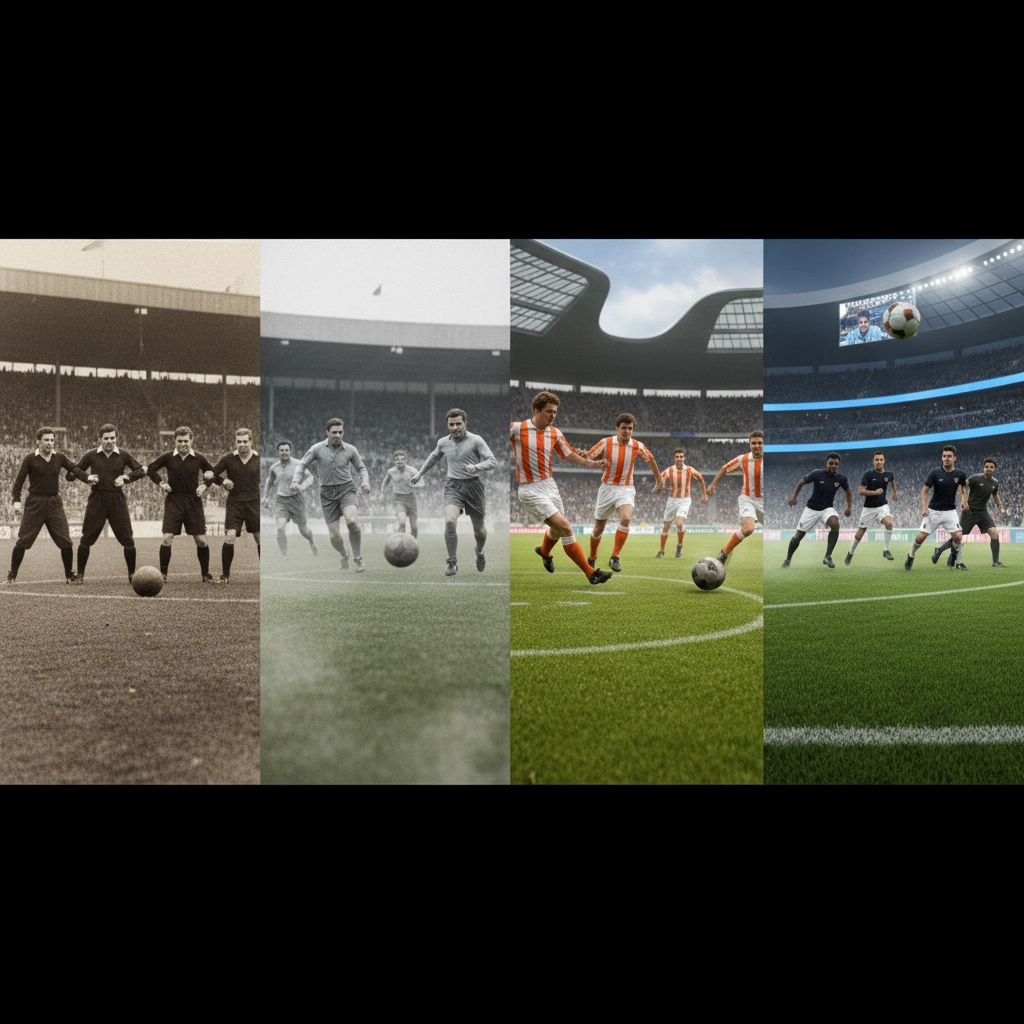
How tactical thinking turned football from pastime to competitive craft
You may think of football as instinctive skill and flair, but tactical evolution is what turned it into a modern, professional sport. From informal kickabouts on village greens to packed stadiums, the way teams organized themselves, interpreted rules, and responded to opposition shaped results as much as individual talent. Understanding the early tactical shifts helps you appreciate why formations, roles, and coaching philosophies became central to the game.
In the early decades, tactics were not yet a formal science. Coaches — where they existed — were often ex-players or club secretaries who experimented with positioning and passing. You’ll notice patterns emerge in response to rule changes, pitch conditions, and the increasing physicality and specialization of players. These patterns laid the groundwork for the first clearly defined systems that dominated the early 20th century.
From muddled lines to the world’s first standard formation: the late 19th–1920s
The rise of the 2–3–5 and the cult of attack
When you study early football, the 2–3–5 formation leaps out. It was the default arrangement for many teams around the turn of the century. With two full-backs, three half-backs, and five forwards, the system prioritized offense and direct play. Matches often produced high scores because defensive structure was minimal by later standards.
- Why the 2–3–5 worked: pitches were uneven, equipment was primitive, and athletic conditioning favored straightforward runs and dribbling.
- Player roles: forwards were expected to create and finish chances; half-backs linked defense and attack but had less positional discipline than modern midfielders.
- Coaching approach: emphasis was on individual skill, supply to the forwards, and physicality rather than intricate team pressing or zonal patterns.
What forced tactical change: laws, travel, and coaching influence
Several practical forces pushed teams away from chaotic attack-heavy setups. You’ll find that changes in laws — such as offside rule adjustments — directly altered how many forwards a team could effectively field. Improved travel and the rise of national and international competitions exposed clubs to diverse playing styles, prompting tactical cross-pollination.
- Rule changes: tweaks to the offside law encouraged deeper defenses and later reduced the effectiveness of packed forward lines.
- Cross-border influence: tours and friendlies introduced English, Scottish, and continental ideas to each other, accelerating evolution.
- Early coaches and tacticians: figures who emphasized passing, space management, and team balance began to appear, slowly professionalizing preparation.
By the late 1920s, you can already see the first major departure from the pure attacking blueprint as teams sought stability and control. The next phase of the tactical story explains how formations like the W–M and the development of positional play reshaped mid-century football — a shift you’ll explore in the following section.
The interwar revolution: W–M, positional discipline, and the modern backline
As rules nudged teams toward more compact defenses, coaches responded with structural innovation. The W–M (3–2–2–3) is the archetypal example: Herbert Chapman’s Arsenal adapted it in the late 1920s and 1930s to neutralize offside-rule changes. What looks like a simple reshuffle was actually a rethink of responsibilities — defenders moved deeper, half-backs became more disciplined, and attackers had defined channels to exploit.
- How the W–M worked: by withdrawing one of the five forwards and pushing a half-back into a defensive line, teams created a three-man backline capable of dealing with through-balls, while retaining width and attacking numbers.
- New positional demands: full-backs increasingly acted as the first layer of organized defense rather than roaming touchline men; centre-halves shifted from midfield destroyers to axis players linking defense and attack.
- Coaching implications: training focused on rehearsed moves, marking assignments, and the timing of forward runs — early signs of set-piece planning and tactical drills.
The interwar period also saw the emergence of alternative systems on the continent. Italy’s Metodo and variations used by Swiss and Austrian teams emphasized compactness and tactical order, while clubs touring internationally brought these ideas into contact with British direct play. The upshot for you as an observer is clear: formations became blueprints rather than loose conventions, and managers began to be judged on their ability to impose shape and rhythm.
Postwar innovations: counters, zonal thinking, and the continental influence
After World War II the tactical conversation accelerated. Two trends dominated the mid-century: systems that prioritized rapid transitions, and those that emphasized defensive organization. In South America, Brazil’s 4–2–4 (perfected in the 1958 World Cup) married defensive solidity with relentless wing play and interchangeable forwards, showing that balance could be beautiful as well as effective.
- Counter-attacking and transitions: teams trained to shift quickly from defense to attack, exploiting space vacated by opponents — a principle that made pace and intelligence essential traits.
- Man-marking vs zonal control: while many coaches still favored strict man-marking, others experimented with guarding spaces rather than players, laying groundwork for later zonal defending and pressing structures.
- Defensive specializations: the concept of a dedicated sweeper or libero — a player free from strict marking duties to mop up danger — began appearing in European teams and would influence catenaccio systems.
By the 1950s and 60s, international tournaments offered tactical laboratories. Hungary’s innovative shape and fluid forward movements embarrassed traditional defenses in the early 1950s; Brazil showcased technical flair built on rigorous positional principles; and Italian clubs refined defensive frameworks that prioritized organization and psychological control of matches. These decades normalized the idea that tactics could be both scientific and stylistic — a blueprint that teams would either copy, counter, or reinvent.
The 1960s–70s breakthrough: Total Football and the triumph of fluidity
If the mid-century pushed the game toward structure, the late 1960s and 1970s swung the pendulum back toward adaptability. Rinus Michels and Ajax (and later the Dutch national team led by Johan Cruyff) introduced Total Football: a system in which players swapped positions seamlessly, pressing as a unit and exploiting space rather than fixed roles. Tactical discipline became the mechanism for freedom.
- Key features: high-intensity pressing, positional rotation, and strong emphasis on ball retention and circulation.
- Legacy: Total Football dissolved rigid formation labels; it also accelerated the importance of technical versatility and tactical intelligence across the squad.
- Counter-movements: other teams responded with compact, counter-oriented approaches (e.g., Italian catenaccio refined by managers like Helenio Herrera) demonstrating that adaptability, not one style, would dominate the tactical imagination.
Between the interwar pragmatism and the fluid revolutions of the 1970s, football became a laboratory of ideas. Coaches no longer merely arranged players on a pitch — they engineered systems that addressed space, tempo, and psychology. This era set the stage for the analytic, pressing-heavy, and positionally nuanced football you see today.
The road ahead: adaptability, data and the human element
Tactics will keep evolving because the game itself is never static. Changes in rules, player profiles, economics and technology continually open new tactical possibilities, but the decisive factor remains human: coaches who can translate ideas into training, players who can execute under pressure, and cultures that value both creativity and discipline. Expect continued blending of styles — pressing systems tempered by possession principles, or rigid structures softened by positional fluidity — rather than a single dominant approach.
Two forces deserve particular attention. First, data and tracking technology are making spatial and physical patterns measurable in real time, changing how teams prepare, scout and adapt during matches. Second, rule changes (from substitution patterns to VAR) and youth coaching philosophies will shape the skillsets available to managers, influencing what tactics are feasible. For a trove of contemporary technical analyses and reports that chronicle these shifts, see UEFA technical reports.
In short, the story of football tactics is not a closed book but an ongoing conversation between rules, individuals, and ideas. The next century of tactical history will be written by those who combine insight with adaptability — and by the players who bring those ideas to life on the pitch.
Frequently Asked Questions
What was the W–M and why did it matter?
The W–M (3–2–2–3) reorganized the traditional five-forward set into a formation with a three-man backline and more disciplined half-backs. It mattered because it transformed formations into deliberate blueprints, introduced clearer defensive responsibilities, and anticipated later developments in positional play and organized defending.
How did Total Football change coaching and player development?
Total Football demanded technical versatility, tactical intelligence and high fitness from every player. Its influence shifted coaching toward developing all-round skills and spatial awareness, encouraging youth systems to produce players comfortable in multiple roles rather than specialists only.
Are modern tactics driven more by analytics or by traditional coaching intuition?
Both matter. Analytics provide new insights into space, pressing triggers and efficiency, but traditional coaching intuition—reading opponents, motivating players, and making real-time decisions—remains essential. The most successful teams combine data-driven preparation with experienced, adaptive coaching on matchday.